
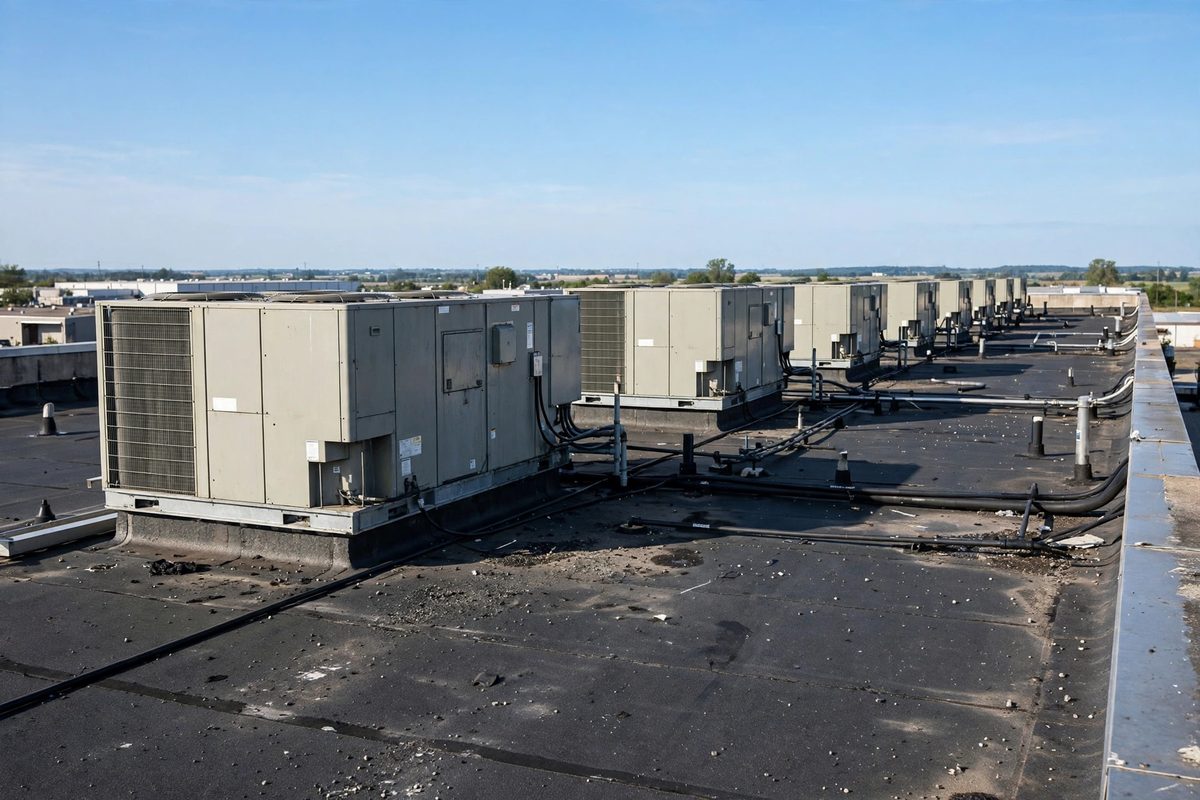
The rooftop unit is the hardest-working machine in your building. It runs ten, twelve, sometimes sixteen hours a day. Nobody thinks about it until the day it quits. Then everyone thinks about it at once. That is when commercial hvac repair earns its keep.
A commercial system is not a big home air conditioner. It has economizers, staged compressors, building controls, and duct runs measured in hundreds of feet. Fixing it takes a different tech with different parts and a different way of thinking. This guide explains the ten problems that bring techs out most often, what drives the cost, and how to hire right.
10 problems commercial hvac repair techs see every week
1. Failed capacitors and contactors. These small electrical parts die more than anything else. Heat kills them. A good tech carries a full kit and swaps them in under an hour. This is the cheapest common call in commercial hvac repair.
2. Refrigerant leaks. Joints vibrate loose. Coils corrode. The system runs longer and cools less until it cannot keep up at all. Finding the leak takes skill and nitrogen, not just a top-off. Topping off without a repair is money thrown away.
3. Dead blower motors and belts. No airflow means no cooling, no matter how well the compressor runs. Belts crack and snap. Motors seize. A belt is a fast fix. A motor is a bigger one, and on some units the whole assembly must come out.
4. Clogged condensate drains. Algae grows in drain lines all summer. The pan overflows. Water finds the ceiling. This floods more commercial spaces than any other single failure, and it is fully preventable.
5. Dirty coils. Rooftop coils collect cottonwood, dust, and grease from kitchen exhaust. Dirty coils raise head pressure, cut capacity, and burn extra power all season. A coil cleaning pays for itself in one summer.
6. Failed control boards and sensors. Modern units think. Boards, sensors, and thermostats talk to each other, and when one lies, the system short-cycles or locks out. Diagnosis is half the job here. The U.S. Department of Energy notes that control faults are among the top energy wasters in commercial buildings.
7. Economizer failures. The economizer is the damper assembly that brings in free cool air when the weather allows. When its motor or sensor fails, the building pays to cool air that the weather would have cooled for nothing.
8. Compressor failure. The big one. Compressors die from bad airflow, low refrigerant, electrical spikes, or plain old age. Replacement is the most expensive common repair in commercial hvac repair, and on old units it triggers the repair-or-replace talk.
9. Duct damage and leaks. Ducts in drop ceilings get crushed by other trades. Flexible runs tear. Leaky ducts can waste a third of your cooling before it reaches a single vent.
10. Thermostat and zoning faults. One zone roasts while another freezes. The cause is often a bad sensor or a stuck damper, not the main unit. Zoning trouble looks scary and usually is not.
What commercial hvac repair usually costs
There is no single price, but there is a clear pattern. You pay for three things: the diagnosis, the part, and the labor to put it in. Emergency hours multiply the labor. That is the whole story.
Small electrical parts and drain cleanings sit at the bottom of the range. Motors, boards, and coil replacements sit in the middle. Compressors sit at the top, and on a large rooftop unit they can exceed the price of a small car.
Four factors move every quote. First, unit size and type. A five-ton packaged unit is one job. A twenty-ton split with building automation is another. Second, access. A unit behind a locked penthouse costs more in time than one on an open roof. Third, parts availability. Common brands mean stocked parts. Odd brands mean ordered parts and a second trip. Fourth, the hour. Nights and weekends cost more everywhere.
Get the diagnostic fee in writing before the work starts. Ask whether it applies to the repair. Ask for the failed parts back or at least a look at them. Honest shops expect these questions.
Repair or replace: the honest math
Every building manager faces this call. The unit is twelve years old. The compressor just died. Do you fix it or start over? Here is how pros think about it.
Multiply the repair cost by the unit’s age in years. If that number is bigger than the cost of a new unit, replacement usually wins. A three-thousand-dollar repair on a fourteen-year-old box is throwing good money after bad. The same repair on a six-year-old box is a no-brainer.
Efficiency matters too. New commercial units use far less power than the ones they replace. The U.S. Department of Energy publishes efficiency ratings that let you compare honestly. On a unit that runs all day, the power savings alone can pay for the change in a few seasons.
Do not let anyone rush you. A failed compressor on a Friday night feels like the end of the world. A temporary repair that buys two weeks is often available, and two weeks is enough time to get three real quotes. The emergency call and the replacement decision do not have to happen on the same night.
How to hire a commercial hvac repair crew
Residential techs are fine people doing a different job. Your building needs a commercial shop. Here is the checklist.
- State license and insurance, verified, not just claimed.
- Real commercial references. Ask for two building managers you can call.
- Factory training or certification on your brand of equipment.
- A stocked truck. Ask what parts they carry. Vague answers mean return trips.
- Written quotes before work, with parts and labor separated.
- Warranty terms in writing, on parts and labor both.
- A maintenance program on offer. Shops that maintain equipment fix it better, because they have seen it before.
Price-shop the diagnostic, not the repair. The cheapest diagnostic in town often comes with the most expensive repair quote. What you want is a fair diagnostic and a straight repair price. One commercial hvac service near me visit on a maintenance plan beats three emergency calls from the cheapest bidder.
What a good service visit looks like
The tech should start with your complaint, then work the system in order: thermostat and controls, power supply, airflow, refrigerant charge. Guessing is not diagnosing. If the first thing the tech does is reach for the refrigerant gauges, watch closely. Gauges come after airflow, not before.
You should see measurements. Superheat and subcooling numbers. Static pressure readings. Amp draws against the nameplate. A pro writes these down and shows you. A guesser says “it just needed gas” and leaves. Any shop that does commercial hvac repair every day will have seen your exact unit before, and the readings prove it.
Before leaving, the tech should tell you three things: what failed, why it failed, and what to watch. “Your capacitor failed from heat” is a fact. “Keep the coils clean and it will last longer” is advice. Both matter. File the invoice with the readings. Next time, any tech starts ahead.
Preventing the next breakdown
Almost every item on the top-ten list gives warning. Capacitors weaken before they die. Drains clog slowly. Coils foul over months. A maintenance program catches these in the cheap stage.
The standard commercial program runs two to four visits a year. Each visit covers filters, belts, coils, drains, electrical connections, refrigerant charge, and controls. It costs a fraction of one emergency compressor call. Buildings that keep the program have fewer surprises. That is not a sales line. It is twenty years of service records talking.
Keep your own log too. Date, company, tech name, readings, recommendations. When you switch shops, hand over the log. A new tech with history beats a new tech without it every time.
Frequently asked questions
How long does commercial hvac repair usually take?
Most common repairs take two to four hours on site. Capacitor, belt, and drain jobs are often done in one visit. Compressor replacements can take a full day, and ordered parts add days of waiting.
Why does commercial hvac repair cost more than residential?
Bigger equipment, harder access, pricier parts, and techs with commercial training. A rooftop unit also takes two people to work on safely in many cases. The scale is different, so the price is different.
Should I sign a maintenance contract?
If your building runs cooling most of the year, yes. The contract buys priority service, known equipment history, and fewer emergencies. Price it against one avoided emergency call. It usually wins. See commercial ac repair for what a scheduled visit covers, and keep emergency ac service near me saved for the nights the contract cannot prevent.
Can my in-house handyman handle commercial hvac repair?
Filters and belt checks, yes. Anything involving refrigerant, high voltage, or gas heat, no. Refrigerant work legally requires certification, and electrical mistakes on commercial gear can be deadly. When the job is beyond filters, call a licensed commercial hvac repair tech.
How do I know the diagnosis is honest?
Ask to see the failed part and the readings that condemned it. Ask what else was checked. A straight tech explains in plain words. If the explanation needs a dictionary, get a second quote.
Next steps
Walk your mechanical rooms this week and write down every unit’s brand, size, and age. Put the service number on the wall next to the panels. Schedule the maintenance you have been postponing. The cheapest commercial hvac repair is the one that never has to happen, and the second cheapest is the one caught early by a commercial hvac repair tech who knows your building.