
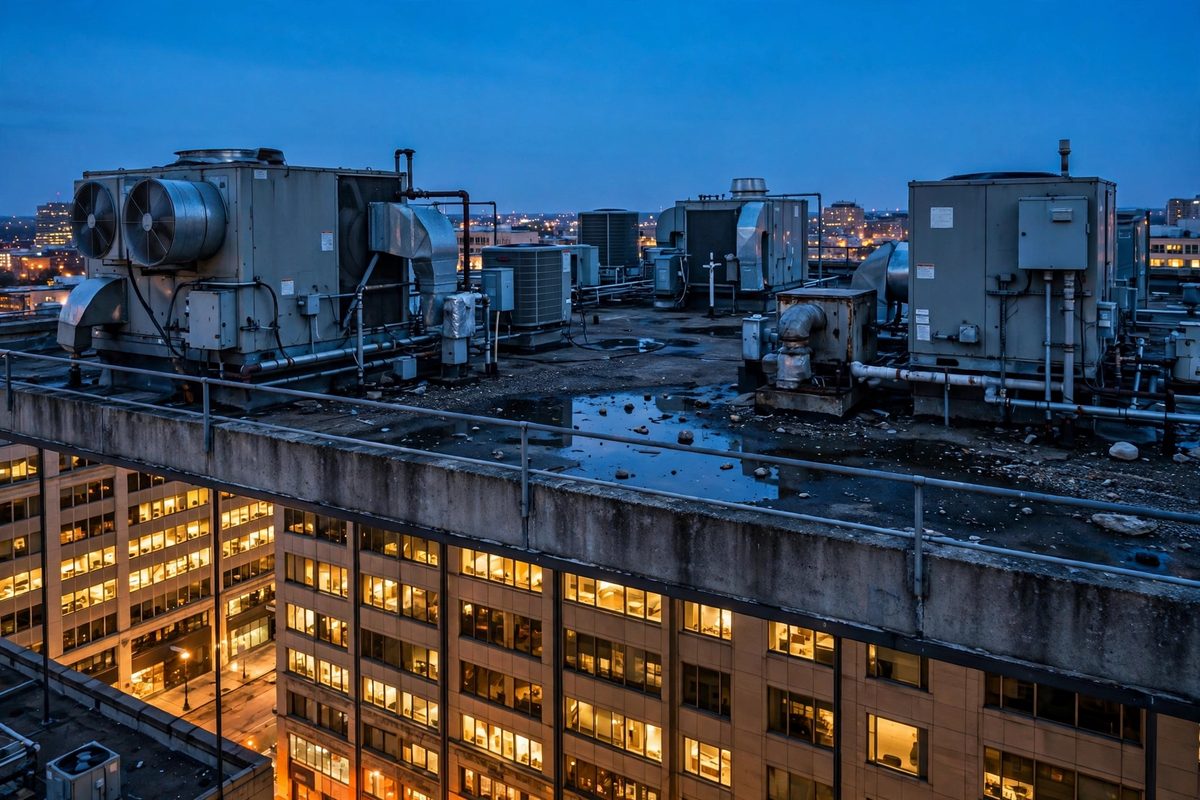
Cooling fails at the worst hour. Friday night. Holiday weekend. The middle of a heat wave. That is why 24/7 AC repair exists for commercial buildings. This guide covers what counts as a real emergency, what it costs, and the five steps to take when your system quits after hours.
What 24/7 AC Repair Means
Round the clock service means a live person answers and a tech rolls, any hour of any day. It does not mean instant arrival. It means the clock starts when you call, not Monday morning.
True 24/7 AC repair shops keep techs on rotating on call shifts. They stock common parts on the truck. They have a dispatcher, not just an answering machine. Ask how the after hours system works before you need it.
Some shops advertise 24/7 but mean “call us and we will call back.” That is not emergency service. Test the line once before summer. If no one picks up at ten at night, find another shop.
What Counts as a Real Emergency
Total cooling loss in occupied space is an emergency. Tenants, staff, and customers cannot wait until morning in extreme heat. Server rooms and telecom closets are emergencies even faster. Electronics cook quickly.
Electrical burning smells are emergencies. Cut power to the unit and call now. Do not restart it to “see if it clears.” Faulty wiring starts fires.
Major water leaks from the system are emergencies. A backed up drain can flood ceilings and ruin interiors within hours. Shut the unit down and call.
Strange loud banging followed by silence is an emergency. Something broke inside. Running it further turns a part replacement into a unit replacement.
A single zone slightly warm is not an emergency. It can wait for morning. Knowing the difference saves you the after hours premium.
5 Emergency Steps When the AC Fails
Step one: check the obvious. Is the thermostat set right? Did a breaker trip? Is the disconnect switch on? Half of all “emergencies” end here. Check before you call.
Step two: if you smell burning or see smoke, cut power and call at once. Do not investigate electrical faults yourself. Get people away from the equipment if needed.
Step three: contain water. If the unit leaks, shut it down and put buckets under the drip. Move anything valuable out of the way. Water damage grows fast.
Step four: call your 24/7 AC repair number. Give the dispatcher the building address, the unit location, the symptoms, and the model number if you have it. Clear facts get you a faster, better prepared tech.
Step five: meet the tech or send someone who can. The tech needs roof or mechanical room access. Locked doors at midnight help no one. Keep a key plan for after hours calls.
What 24/7 AC Repair Costs
After hours work costs more. The premium covers the on call tech, the dispatcher, and the disruption. Expect a higher diagnostic fee and a higher hourly rate than daytime calls. Ask for the exact numbers when you set up the account, not at midnight.
Parts cost the same whatever the hour. Labor is where the premium lives. Some shops charge time and a half. Some double the rate. Know your shop’s structure.
The cheapest emergency call is the one you avoid. Maintenance plans with priority service often waive or reduce after hours fees for contract customers. If your building depends on cooling, the plan pays for itself with one avoided crisis.
Get the invoice itemized. Parts, labor hours, and the after hours surcharge should each appear as separate lines. Vague totals hide padding.
Setting Up 24/7 AC Repair Before You Need It
Do this work on a calm Tuesday, not during a crisis.
- Pick a commercial shop with real after hours dispatch. Test the number at night.
- Put the emergency number in three places: the mechanical room, the manager’s phone, and the building log.
- Give the shop your equipment list in advance. Model numbers speed parts decisions.
- Agree on who can authorize after hours work and up to what amount.
- Walk the tech to every unit once, in daylight, so they know the building.
- Keep roof and mechanical room keys accessible for on call staff.
For efficiency background, see the U.S. Department of Energy. For system standards, see ASHRAE.
More on this site: emergency ac service near me for finding local help, commercial ac repair for common fixes, and commercial hvac service near me for service contracts.
After the Emergency Visit
Read the service report. It should state what failed, what was fixed, and what needs follow up. Emergency fixes are sometimes temporary. Know what is permanent and what needs a return visit.
Schedule the follow up now. Do not let a temporary fix become permanent by forgetfulness. Put it on the calendar before the tech leaves.
Ask why it failed. The answer guides prevention. A clogged drain needs a maintenance change. A burnt contactor needs electrical checks. Every failure teaches something.
Update your plan. If the call exposed a gap, close it. Maybe you need a second shop as backup. Maybe the key plan failed. Fix the system, not just the unit.
24/7 AC Repair Service Agreements
A handshake deal fails at midnight. A written agreement holds. If your building needs round the clock coverage, put it in a contract.
The agreement should name the covered equipment. List every unit by location and model. No list, no coverage disputes later.
It should state response times in plain numbers. Emergency calls get a maximum response window. Urgent calls get another. Routine calls get a third. Vague words like “prompt” belong nowhere in the document.
It should fix the after hours rates. Diagnostic fee, hourly rate, and any surcharge, all in writing. Review these yearly. Rates creep.
It should define authorization. Who can call for after hours work? Up to what dollar amount without extra approval? Midnight is a bad time to hunt for the boss.
It should cover parts. Does the shop stock common parts for your models? What happens when a part must be ordered? Get the answers now.
One page of clear terms beats ten pages of legal fog. If you cannot understand it, do not sign it.
Training Your Staff for 24/7 AC Repair Calls
The best 24/7 AC repair plan fails if your people freeze. Train them.
Show every shift lead the shutoffs. Power disconnects, water valves, thermostat overrides. Label them with clear tags. In a crisis, no one should hunt.
Post the call script by the phone. Building name and address. Unit location. Symptoms in plain words. The on call contact’s name and number. Reading beats remembering at 2 a.m.
Run a drill once a year. Walk through a fake failure. Time the response. Find the gaps while the sun is up.
Teach the check first rule. Thermostat setting, breaker panel, disconnect switch. These three checks solve many midnight scares. Staff who check first save everyone time.
Debrief every real call. What went well? What was slow? Update the plan with what you learn. A plan that never changes is a plan that never improves.
Frequently Asked Questions
How fast does 24/7 AC repair respond?
Good shops promise a response window, often one to four hours for true emergencies. Ask for the written promise when you sign up. Distance and call volume affect real times.
Is 24/7 AC repair worth the premium?
When cooling loss stops business or threatens equipment, yes, without question. One saved weekend of operations dwarfs the surcharge. For non urgent issues, wait for morning.
What should I tell the dispatcher?
Address, unit location, what happened, what you see and smell, and the model number. Also say who will meet the tech and how to reach them. Five facts, fast dispatch.
Can any HVAC shop do 24/7 AC repair?
No. Real round the clock service needs on call techs, stocked trucks, and dispatch. Many shops claim it and few deliver it. Verify before you depend on it.
How do I avoid needing 24/7 AC repair?
Twice yearly maintenance, clean filters, clear drains, and prompt attention to small symptoms. Most midnight failures gave warnings for weeks. Listen early.
Next Steps
Program the emergency number into your phone today. Tape it inside the mechanical room door. Brief your on call staff on the five steps. Then hope you never need them. Good 24/7 AC repair starts long before the failure, with a shop you trust and a plan your team knows.
One last note. Keep a simple log of every after hours call. Note the problem, what was done, and the cost. Review it each fall. Patterns in the log tell you which units to replace and which shop earns your trust. Buildings that track their emergencies have fewer of them. Start the log tonight. It takes five minutes and it pays back all year.