
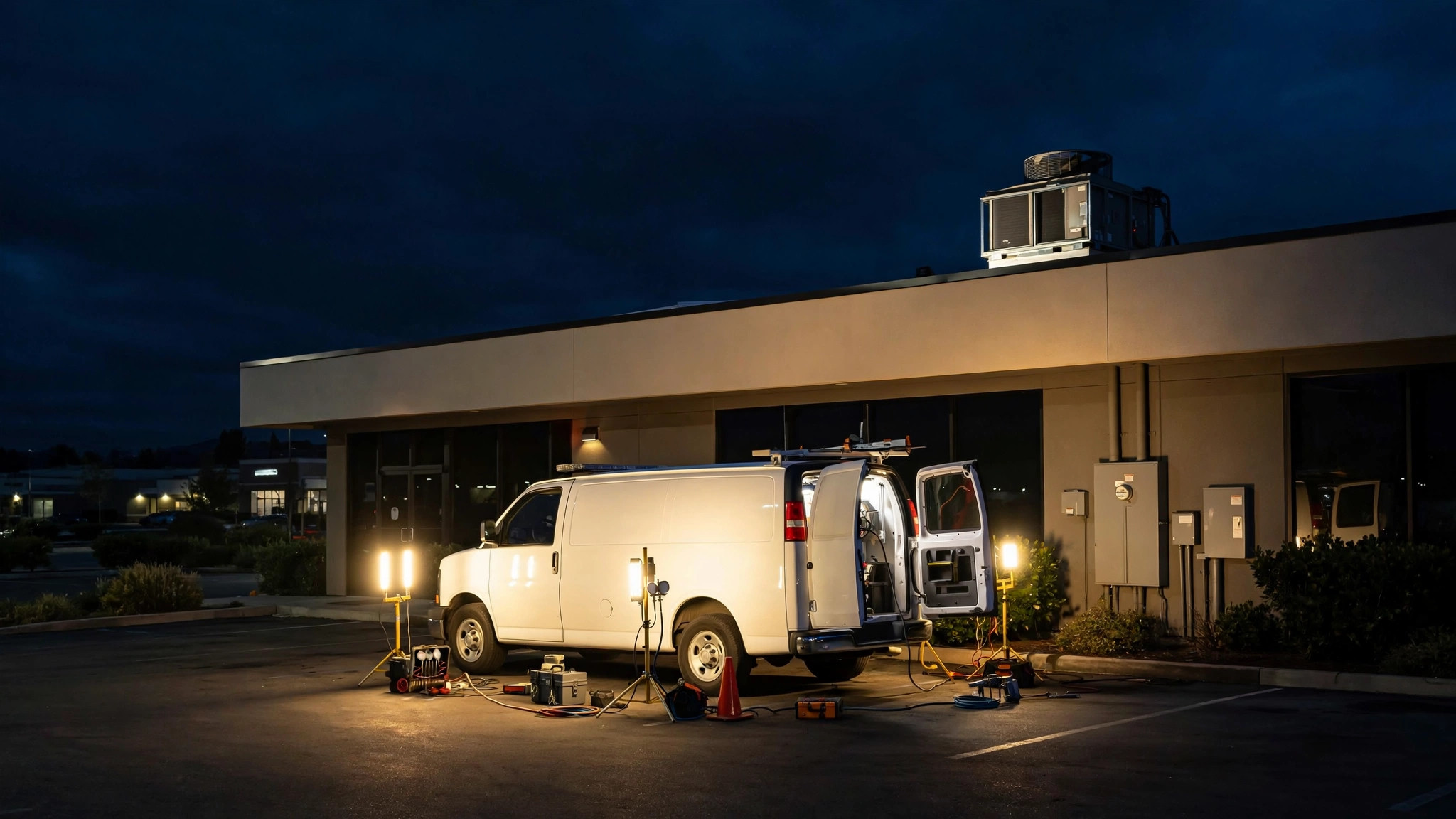
An ac repair emergency never waits for a good time. The cooling dies at noon in midsummer. Tenants call. Customers sweat. Equipment in server rooms starts to cook. Every hour of downtime costs money and trust. This guide gives building owners and facility managers a clear plan for your next breakdown. You will learn what counts as a true emergency, the steps to take in the first hour, what it costs, and how to pick a crew that shows up fast.
What Counts as an ac repair emergency
Not every warm afternoon is an ac repair emergency. Some problems can wait for a scheduled visit. A true emergency has one of three traits. First, safety is at risk. Second, the business cannot operate. Third, damage is spreading while you wait.
Complete cooling loss in a retail store, office, or restaurant counts. So does a system blowing warm air during a heat wave. Refrigerant leaks count too, because refrigerant exposure harms people and the environment. Electrical burning smells from the air handler count as an immediate emergency. Call the fire department first if you smell burning wire, then call your tech.
A slow decline in performance is not an ac repair emergency. Uneven temperatures across rooms can wait a day or two. A noisy fan that still cools can wait for normal hours. Save the emergency rate for true emergencies. You pay a premium for after-hours service, so spend it only when the situation demands it.
Why Fast Response Matters in an ac repair emergency
Heat damage moves fast. Indoor temperatures in a dark building climb five to ten degrees an hour on a hot day. Staff productivity drops as rooms heat up. Customers walk out of uncomfortable stores. Restaurants face food safety rules that do not bend for broken compressors.
Equipment suffers too. Server rooms have strict temperature limits. Medical offices store samples and drugs that need stable cooling. A short cooling failure can turn into a large inventory loss if nobody acts. The longer the system sits dead, the harder the restart. Compressors that short-cycle in heat can burn out completely, turning a repair into a replacement.
Quick action also saves the repair itself. Many faults are small at first. A loose belt becomes a seized motor. A clogged drain becomes a ceiling collapse. Calling early during a cooling crisis keeps a small bill from growing into a large one.
9-Step ac repair emergency Response Plan
When cooling fails, work this checklist in order. Stay calm. Speed helps, but so does order.
- Check the thermostat. Make sure it is set to cool and the set point is below room temperature. Dead batteries cause more false alarms than any other single item.
- Check the breaker panel. A tripped breaker is common after power flickers. Reset it once. If it trips again, leave it off and call a tech.
- Check the disconnect switch. Rooftop and outdoor units have a disconnect box nearby. Make sure it is in the on position. Storms and vandals flip them.
- Look for obvious blockage. Weeds, trash, and pallets choke outdoor coils fast. Clear debris a few feet around the unit.
- Check for water. Look under air handlers for standing water. A flooded drain pan can trip a safety switch and kill the system. Do not touch standing water near electrical gear.
- Note the symptoms. Write down what you see and hear. Warm air from vents, ice on lines, strange smells, odd noises. The tech will ask.
- Call your service provider. Give the building address, unit location, and your symptom notes. Ask for the arrival window and the emergency rate.
- Protect the space. Move heat-sensitive stock to cooler rooms. Open doors for airflow if security allows. Bring in portable fans or rental cooling if the wait is long.
- Document everything. Take photos of the unit, the thermostat reading, and any visible fault. Note the time of each step. This helps with warranty and insurance claims.
Keep this list posted near your mechanical room. A calm checklist beats panic every time.
Common Causes of ac repair emergency Calls
Most failures share a few root causes. Knowing them helps you describe the problem and judge the quote.
Refrigerant leaks top the list. Vibration rubs copper lines against metal edges. Coils corrode in coastal and industrial air. Low refrigerant freezes the coil, then overheats the compressor. A leak search and recharge is the standard fix.
Electrical failures come next. Contactors weld shut. Capacitors swell and die in heat. Rodents chew low-voltage wire. These faults often strike on the hottest days, when the system works hardest.
Airflow problems round out the big three. Filters clog when maintenance slips. Blower motors fail. Ducts collapse in old buildings. Poor airflow makes the coil freeze, which looks like a refrigerant problem but is not. A good tech checks airflow before adding refrigerant.
Neglected maintenance underlies almost all of them. The [U.S. Department of Energy](https://www.energy.gov/) notes that regular service keeps cooling systems running near peak efficiency. Skipped service turns small wear into emergency failures.
Cost Factors for ac repair emergency Service
Emergency pricing runs higher than scheduled work. Expect a premium of 50 to 100 percent over normal rates. Here is what sets the final number.
After-hours timing drives the biggest share. Night, weekend, and holiday calls carry trip surcharges. A job that costs 400 dollars at noon can cost 800 at midnight. Ask the rate before the truck rolls.
The failed part sets the parts cost. Capacitors and contactors are cheap. Compressors and control boards are not. Your tech should name the failed part and show you the old one.
System size and access matter. Rooftop units need ladders or lifts. Split systems buried in tight closets take longer. Bigger buildings have bigger systems with bigger price tags.
Refrigerant type affects cost too. Older refrigerants cost more per pound and face phase-down rules. The tech must weigh in the charge by scale, not by guess. Ask for the per-pound rate up front.
Diagnostic time is real labor. Finding the fault can take an hour on a complex system. Flat-rate diagnostic fees are fair. Open-ended hourly billing with no cap is not. Get the diagnostic terms in writing before work starts.
Questions to Ask Before You Approve the Work
The tech arrives. You are hot and stressed. Ask these questions before you sign anything.
What failed, and can you show me? A straight tech points at the bad part. What are my options, repair or replace? Some failures signal the end of an old unit. What is the total price, parts and labor? Get the number before the wrench turns. Is the part under warranty? Factory warranties can cut the parts cost to zero. How long will the fix hold? Ask for a plain answer about expected life. These questions take two minutes and save real money.
Preventing the Next ac repair emergency
The cheapest emergency is the one that never happens. A service agreement with spring and fall visits catches most failures early. Techs check refrigerant charge, electrical connections, coils, drains, and belts. The [ASHRAE](https://www.ashrae.org/) guidelines for commercial buildings stress routine inspection of HVAC systems to prevent surprise breakdowns.
Do your own simple checks between visits. Change filters on schedule. Keep outdoor units clear of debris. Listen for new noises. Log any odd behavior and report it at the next visit. Train your staff to report warm spots early instead of suffering in silence.
Consider monitoring. Simple sensors now watch temperature, current draw, and run time. They alert you before the failure. For buildings with server rooms or cold storage, monitoring pays for itself with one prevented incident.
Related Reading
For scheduled cooling work, see [commercial ac repair](/commercial-ac-repair/). For full system service beyond cooling, read [commercial hvac repair](/commercial-hvac-repair/). If you are weighing new equipment, see [commercial heating and cooling](/commercial-heating-and-cooling/).
Choosing Your ac repair emergency Provider
Do not shop for an emergency provider during the crisis. Pick your company now, before the failure. Look for a firm with true 24-hour dispatch, not an answering service that pages someone. Ask their average response time in your area. Under two hours is good. Under four is acceptable.
Check licensing and insurance. Commercial HVAC work needs proper credentials in most states. Ask if their techs carry common commercial parts on the truck. A stocked truck means one visit, not three. Get the emergency rate schedule in writing now. Tape it inside your mechanical room door.
Call two or three firms for references from buildings like yours. A company that serves offices may not know restaurant rooftop units. Match their experience to your equipment. The ENERGY STAR program at [energystar.gov](https://www.energystar.gov/) offers owner resources on maintaining commercial cooling equipment efficiently.
FAQ
How fast should an emergency crew arrive?
Aim for under two hours in metro areas. Four hours is reasonable in outlying areas. Ask for the arrival window when you call, and get a callback if they miss it.
What should I do while waiting for the tech?
Protect people, stock, and equipment first. Move heat-sensitive items to cooler rooms. Open doors for airflow where security allows. Note symptoms and take photos for the service record.
Can I reset the system myself during an emergency?
You can check the thermostat, breakers, and disconnect switch once. Do not open electrical panels or handle refrigerant lines. Those jobs need a licensed tech and proper tools.
Will an ac repair emergency void my warranty?
No, if the repair follows the maker rules. Use licensed techs and approved parts. Keep every invoice with part numbers. Skipping required maintenance is what usually voids coverage, not the emergency call.
Should I repair or replace after a major failure?
Compare the repair cost against the unit age and efficiency. A repair under a third of replacement cost usually wins on units under ten years old. On older units, put the money toward new equipment.
Next Steps
Pick your emergency provider this week, before the next heat wave. Get the rate schedule in writing. Write your ac repair emergency provider’s number on the unit itself. In a real ac repair emergency, nobody has time to search files. Post the 9-step response plan in your mechanical room. Book a spring maintenance visit. A crisis handled with a plan costs less, ends sooner, and hurts nobody. Preparation is the whole game.



