
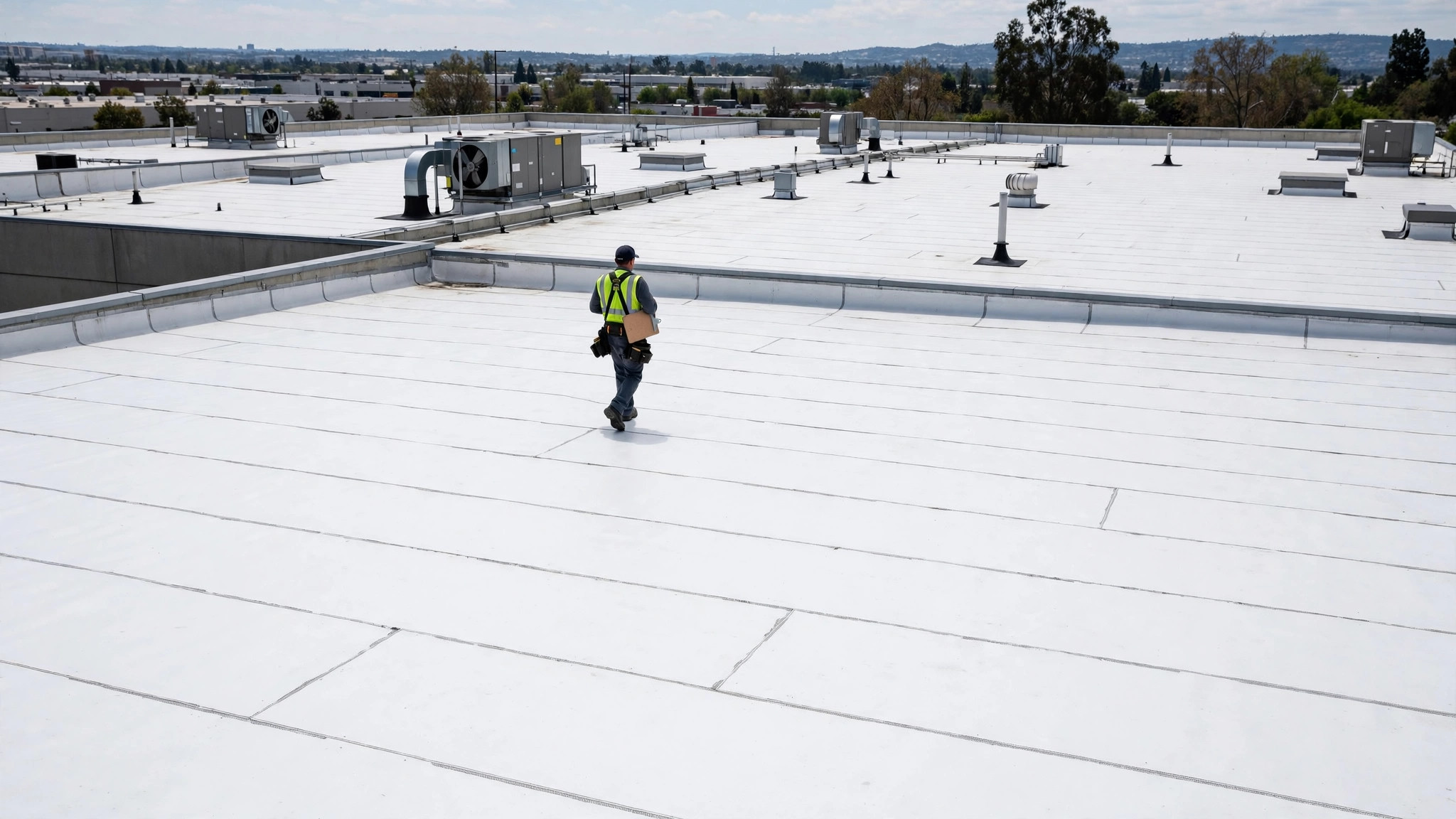
Commercial roof maintenance programs are service agreements that keep your building’s roof in good shape year after year. Instead of calling a roofer only when a leak appears, you sign up for scheduled inspections, cleanings, and minor repairs. For owners of offices, warehouses, and stores across the United States, these programs are the standard way to make a roof last its full life.
Roofs fail slowly and then all at once. Small membrane cuts, clogged drains, and cracked sealant sit unnoticed for months. Then one storm pushes water through, and you face damaged ceilings, ruined inventory, and an emergency repair bill. Commercial roof maintenance programs exist to break this cycle. A roofer checks the roof on a set schedule, fixes small issues fast, and gives you a written record of the roof’s condition.
The 6 Types of commercial roof maintenance programs
Not all commercial roof maintenance programs look the same. Here are the six common types you will see in the market.
First is the inspection-only plan. The roofer walks the roof twice a year, writes a report with photos, and recommends repairs. You approve each repair separately. This is the lowest-cost option and works for owners who want eyes on the roof but prefer to manage repairs themselves.
Second is inspection plus minor repairs. The roofer inspects and also fixes small items on the spot: sealing punctures, clearing drains, and recaulking flashings. Repairs up to a set dollar amount are included. This is the most popular type because it handles the small stuff without a phone call.
Third is the full-service plan. It covers inspections, cleanings, minor repairs, and a set amount of larger repair work each year. Some full-service plans include leak response with guaranteed arrival times. This suits owners who want one contract to cover nearly everything.
Fourth is the warranty-maintenance plan. Some roof makers and contractors tie the program to the roof warranty. The contractor performs the maintenance the warranty requires and keeps the records the maker needs. If you have a newer roof under warranty, this type protects that coverage.
Fifth is the multi-site plan. Owners with several buildings get one contract covering all roofs, often at a per-square-foot rate with a volume discount. One contractor learns all your buildings, which speeds up service.
Sixth is the coating and restoration plan. This type pairs maintenance with a planned roof coating or restoration project. The contractor maintains the roof now and applies a reflective coating on a set schedule to extend its life. It works well for aging roofs that are still sound.
What commercial roof maintenance programs Should Cover
Every one of the commercial roof maintenance programs above should spell out the same core tasks. Twice-yearly inspections are the base: one in spring to catch winter damage, one in fall to prep for winter. After-storm checks should be available or included.
The task list should name each item: membrane and seam inspection, flashing checks at pipes and curbs, drain and gutter clearing, debris removal, sealant inspection, ponding water notes, and edge metal checks. Minor repairs should list what is included, such as puncture patches, seam reseals, and caulking, plus the dollar cap per visit.
Reports matter as much as the work. After each visit, you should get a written report with photos and a marked roof plan. This record proves the roof was maintained, which supports warranty claims and insurance. Ask to see a sample report before you sign anything.
Leak response terms should be in writing. How fast does the crew arrive when you call about a leak? Same-day or next-day response is standard in good programs. Also check whether emergency calls cost extra or come at a discount for program members.
Commercial roof maintenance programs: Cost Factors
Pricing for commercial roof maintenance programs usually runs by roof size, with per-square-foot or flat annual fees. A small retail building might pay a few thousand dollars per year for an inspection-plus-minor-repairs plan. A large warehouse with many penetrations pays more.
Several factors move the price. Roof area is the biggest. Roof type matters too: single-ply membranes, built-up roofs, and metal each need different time. Age matters because older roofs need more repair hours. Access matters: a roof that is easy to reach costs less to service than one with locked hatches and tight parapets.
What is included drives the biggest price differences. An inspection-only plan costs the least. Adding minor repairs raises the price but saves you from approving small jobs one by one. Full-service plans cost the most but cover nearly everything. Compare the task lists, not just the totals.
Watch for extras. Some programs bill drain clearing, debris hauling, or after-hours leak calls separately. Others include them. Ask for a list of exclusions so you can compare bids fairly. A slightly higher base price often covers more and costs less overall.
For cost benchmarks on repairs, see commercial roof repair cost per square foot. For building your own inspection routine, read commercial roof inspection checklist. To understand common failures, see common commercial roof problems.
How to Compare commercial roof maintenance programs
Start by getting three bids from contractors who specialize in commercial roofs. Ask each one for the same things: the visit schedule, the full task list, the repair cap per visit, the report format, leak response time, and the contract term.
Line up the task lists side by side. One bid may look cheap until you see it skips drain clearing. Another may include full debris removal and minor repairs up to a generous cap. The task list is where the real value lives.
Check the contract term and exit rules. A one-year term with clear renewal terms is fair. Avoid programs that lock you in for several years with heavy cancel fees. Also check how price increases work at renewal.
Look at the contractor, not just the paper. How long have they run commercial roof maintenance programs? Can they show references from buildings like yours? Do they carry proper insurance? A program is only as good as the crew that shows up.
Ask about the technician. A program that sends the same tech each visit builds real knowledge of your roof. That tech notices small changes that a rotating crew would miss. Ask whether the contractor assigns a dedicated tech to each account.
Red Flags in commercial roof maintenance programs
Be wary of programs with no written task list. A handshake promise to “check the roof twice a year” means nothing when a dispute arises. Everything should be in the contract.
Beware of very low prices. A plan that costs far less than the others probably covers far less. Some cheap plans are just a quick walk-through with no cleaning and no repairs. You get what the task list says, and a thin list means thin value.
Watch for repair markups. Some programs sell a cheap plan and then overcharge for every repair they find. Ask how repairs are priced before you sign. Fair programs use clear unit prices or time-and-materials rates.
Avoid programs that skip reports. No report means no record. Without records, you cannot prove maintenance for warranty claims, and you cannot track whether problems are growing. Insist on written reports with photos.
Finally, check the leak response promise. A program that claims fast response but has no crew available during storms is not worth much. Ask how many crews they run and how they handle peak demand.
Getting the Most From Your Program
Sign the contract, then use it. Put visit dates on your building calendar. Make sure the tech can reach the roof: unlock hatches, clear the mechanical room, and provide a building contact. Missed visits waste the money you paid.
Read every report the week it arrives. Reports flag issues with photos and locations. Approve recommended repairs fast. A puncture flagged in spring becomes a leak by fall if you sit on it.
Tell other contractors about the program. When HVAC techs, plumbers, or solar installers work on the roof, they can cause damage. Require them to report roof work, and ask your roofer for a check after major trade work. Some owners add walk pads along service paths to cut traffic damage.
Keep your records organized. File each report, invoice, and repair record in one place. This folder is gold when you sell the building, file a warranty claim, or talk to your insurer. It proves the roof was cared for.
Review the program each year. Is the roof holding up? Are repairs trending down? If the roof keeps needing major work, it may be time to talk about restoration or replacement instead of more patching. A good contractor will tell you honestly when that point arrives.
When you compare commercial roof maintenance programs, ask each bidder how they document their work for warranty purposes. The National Roofing Contractors Association explains what proper documentation looks like at https://www.nrca.net/, and OSHA outlines fall-protection rules that apply to roof crews at https://www.osha.gov/. The best commercial roof maintenance programs treat the roof as a managed asset, with scheduled visits, written reports, and a clear repair history you can hand to a buyer or insurer.
What do commercial roof maintenance programs typically cost?
Costs vary by roof size, type, age, and location. Small buildings often pay a few thousand dollars per year for inspection-plus-minor-repairs plans. Large or complex roofs cost more. Full-service plans run higher. Always compare task lists, not just prices.
How many visits do commercial roof maintenance programs include?
Most include two visits per year, spring and fall. Some add a third visit or after-storm checks. Buildings with heavy foot traffic, many penetrations, or older membranes may need quarterly visits.
Do commercial roof maintenance programs cover leak repairs?
Inspection-plus plans usually cover minor repairs up to a set cap. Larger leak repairs are often billed separately, sometimes at a member discount. Full-service plans may include more repair work. Check the contract for the exact terms.
Will a program keep my roof warranty valid?
Most roof warranties require regular inspections and prompt repairs with records. A good program provides exactly that. Keep every report and invoice, since the maker will ask for them if you file a claim.
Can one program cover multiple buildings?
Yes. Multi-site commercial roof maintenance programs are common. One contractor covers all your roofs under a single contract, usually with volume pricing. This works well for owners with several properties in one region.
Next Steps
List your buildings and roof types. Get three bids from commercial roofing contractors in your area. Compare the task lists line by line, check references, and read the contract before you sign. Once the program starts, keep the visits on schedule and read every report. Steady care is the cheapest roof you will ever own.



