
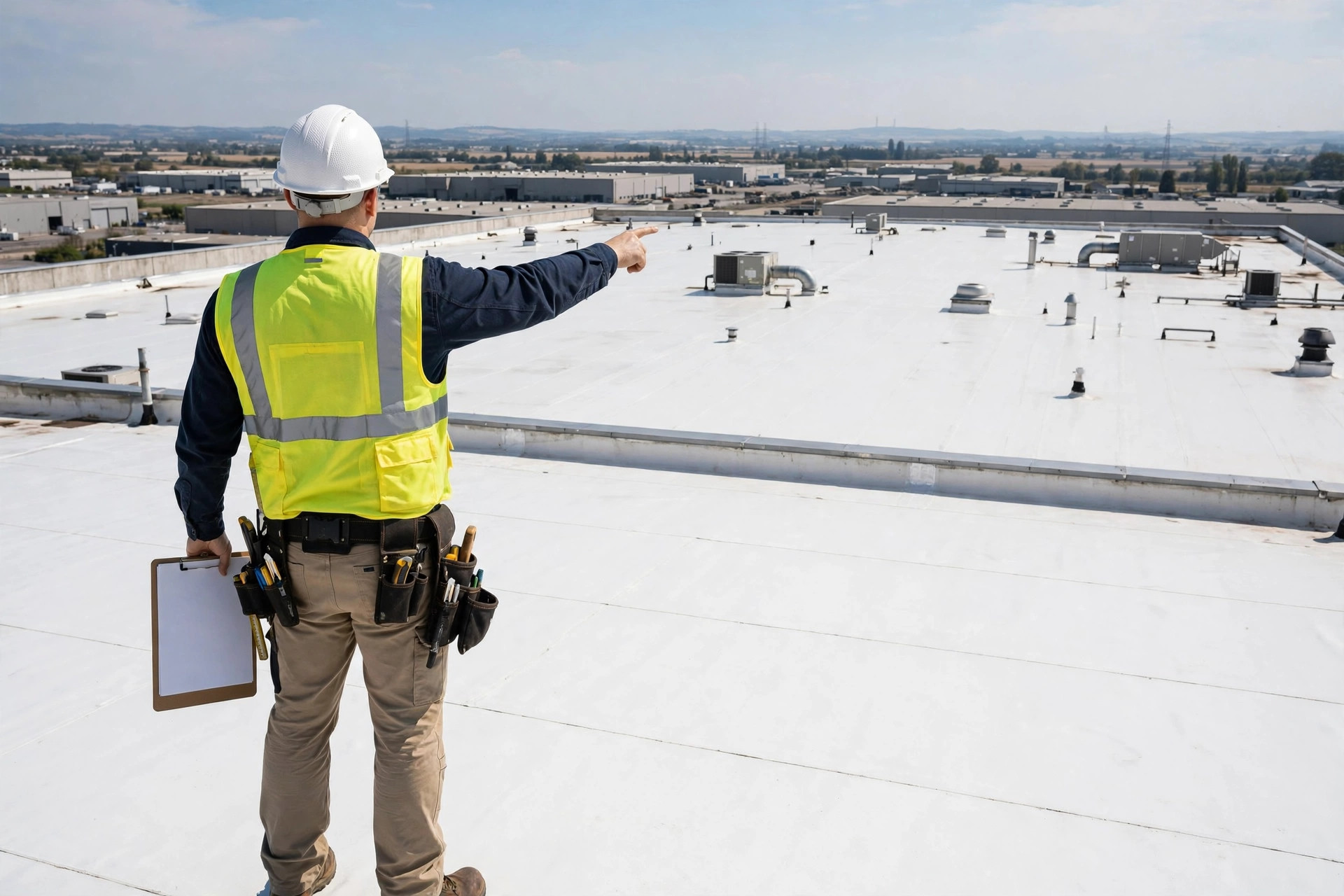
A commercial roofing contractor is the company that installs, repairs, and maintains roofs on offices, warehouses, stores, schools, and other non-residential buildings. Choosing the right commercial roofing contractor is one of the most important decisions a building owner makes. The roof protects everything below it, and the contractor’s skill decides whether that protection lasts decades or fails in a few seasons.
The best way to choose is to ask the right questions before signing anything. This guide gives nine key questions every owner should ask a commercial roofing contractor, explains what good answers sound like, lists the cost factors, and covers the red flags that mean walking away.
Question 1: Are You Licensed and Insured as a Commercial Roofing Contractor?
Start with the basics. Ask for the state roofing license number and verify it is current and covers commercial work. Then ask for proof of general liability and workers’ compensation insurance with limits sized for commercial jobs.
Get the insurance certificates sent directly from the insurer, not just photocopies from the contractor. For large projects, ask about bonding as well. A commercial roofing contractor who hesitates on paperwork is not worth further time. For a deeper vetting guide, see how to choose a commercial roofing contractor.
Question 2: How Much of Your Work Is Commercial?
A commercial roofing contractor should do commercial work as a core business. Ask what share of jobs are commercial and what size buildings they typically handle. Ask about experience with your specific roof system, whether TPO, EPDM, modified bitumen, built-up, metal, or spray foam.
A firm that mostly does house roofs may not understand commercial drainage, tapered insulation, or the codes that govern commercial work. Match the contractor’s experience to your building.
Question 3: Can I See References from Similar Buildings?
Ask for three references from commercial jobs similar to yours in size and roof type. Call them. Ask whether the crew finished on schedule, stayed on budget, kept the site clean, and whether the roof performed in the first heavy rain.
Ask the key question: would you hire this commercial roofing contractor again? References reveal what brochures cannot. A strong contractor shares them proudly.
Question 4: What Manufacturer Certifications Do You Hold?
Top material makers certify installers who meet their standards. Ask which brands the commercial roofing contractor is certified to install and what warranty level that certification unlocks. Certified status often means access to stronger system warranties covering both materials and workmanship.
For large projects, verify the certification with the maker. Paper claims are easy to make. Real certification is earned through training and proven work.
Question 5: Will You Inspect the Roof Before Quoting?
The answer must be yes. A commercial roofing contractor who quotes without walking the roof, checking drains and flashing, and taking measurements is guessing. Good estimators explain their findings in plain words with photos.
Note how thorough the inspection is. It predicts the care the crew will bring to the job. A quick glance from the ladder is a warning sign. The National Roofing Contractors Association offers owner resources on working with roofers at NRCA.
Question 6: What Exactly Is Included in Your Quote?
Ask for a detailed written quote naming materials by brand and thickness, insulation type and R-value, flashing details, warranty terms, schedule, and payment milestones. Vague quotes hide costs that appear later as change orders.
Compare quotes line by line across bidders. Make sure every bid covers the same scope. A commercial roofing contractor with a clear, complete quote is usually a clear, complete operator.
Question 7: How Do You Handle Safety on the Roof?
Roofing is dangerous work. Ask for the written safety plan and confirm the crew uses fall protection as required by federal rules on commercial roofs. Ask about the company’s safety record.
Safety and quality travel together. A crew that cuts corners on harnesses will cut corners on seams. Federal standards from OSHA set the legal baseline, and the best contractors exceed it.
Question 8: What Warranties Do You Offer?
Ask about both warranties: the manufacturer’s coverage on materials and the contractor’s coverage on workmanship. Get the lengths, the terms, and what voids them in writing.
Understand the difference. A long manufacturer warranty means little if the workmanship warranty is weak, since most early failures come from installation errors. A commercial roofing contractor who stands behind the work puts it in writing without being pressed.
Question 9: Do You Offer Maintenance After the Job?
Roofs need care after installation. Ask whether the commercial roofing contractor offers maintenance plans, how service calls work, and what response times to expect. A company with a real service department is a better long-term partner than an install-only shop.
Maintenance agreements also keep many manufacturer warranties valid. Ask what each visit includes and get it in writing. For related service insight, see commercial roof services.
What Good Answers Sound Like from a Commercial Roofing Contractor
Knowing the questions is half the job. Knowing good answers is the other half. Here is what to listen for.
On licensing and insurance. A good commercial roofing contractor gives the license number immediately and offers to have certificates sent from the insurer. Bad signs include vague claims, expired documents, or irritation at being asked.
On commercial experience. Good answers name specific building types, roof systems, and project sizes. The contractor describes recent similar jobs without hesitation. Vague talk about “lots of experience” with no details is empty.
On references. Good contractors hand over a list with names and numbers. They may even suggest driving by past projects. Reluctance to share references means there is something to hide.
On the quote. Good quotes are detailed and written, with materials named and scope clear. The estimator walks through the quote and answers questions patiently. Pressure to sign on the spot is the opposite of good.
On warranties. Good answers explain both manufacturer and workmanship warranties in plain words, including what voids them. Evasive or overly rosy warranty talk deserves skepticism.
On maintenance. Good contractors describe their service department, visit checklists, and response times. They treat the roof as a long-term relationship, not a one-time sale.
Listen as much to the tone as to the words. The commercial roofing contractor who answers directly, admits limits, and puts everything in writing is the one to hire.
Commercial Roofing Contractor Cost Factors
Use this checklist to understand what drives a commercial roofing contractor’s pricing.
- Project type. Inspections cost little. Full replacements cost a lot.
- Roof size and complexity. Bigger and more complex roofs need more labor.
- System and materials. Different systems need different skills and parts.
- Roof condition. Neglected roofs need more repair work.
- Timing. Emergency and storm-season work carries premium rates.
- Warranty level. Stronger warranties may add a little to the price.
- Local labor rates. Prices vary by region and season.
Red Flags When Hiring a Commercial Roofing Contractor
- No license number or proof of insurance.
- Quotes without a roof inspection.
- Demands for large cash payments upfront.
- Pressure to sign immediately.
- No written workmanship warranty.
- Poor reviews or unresolved complaints.
Any of these ends the conversation. Plenty of honest firms will earn the work properly.
Commercial Roofing Contractor FAQs
How many quotes should I get from a commercial roofing contractor?
Three detailed quotes is the standard advice. Fewer leaves you guessing about fair price. Ensure each covers the same scope so the comparison is honest.
Should I always pick the lowest bid?
Rarely. Very low bids usually mean omitted scope, cheaper materials, or uninsured labor. The best value is a fair-priced bid from a qualified firm with strong references and clear warranties.
How long should a commercial roofing project take?
It depends on size, system, and weather. Repairs finish in days. Full replacements take weeks. The contractor should provide a written schedule and update it if conditions change.
What should I do before the crew arrives?
Clear roof access, move vehicles from drop zones, notify tenants of noise and schedule, and protect sensitive interior areas below the work. A good contractor provides a preparation list.
How do I verify a commercial roofing contractor’s license?
Check with the state licensing board, usually online. Confirm the license is active, covers roofing, and has no serious disciplinary actions. It takes only a few minutes.
Next Steps for Building Owners
Hiring a commercial roofing contractor comes down to asking the nine questions and judging the answers. Verify license and insurance, confirm commercial experience, check references and certifications, demand detailed quotes, and test communication. The contractor who passes every check is the right one for the building. Choose with care and the roof will serve quietly for decades. The time spent asking questions now prevents years of regret later. A careful hiring process is the foundation of every successful roofing project. Start asking today. Your roof deserves it.



