
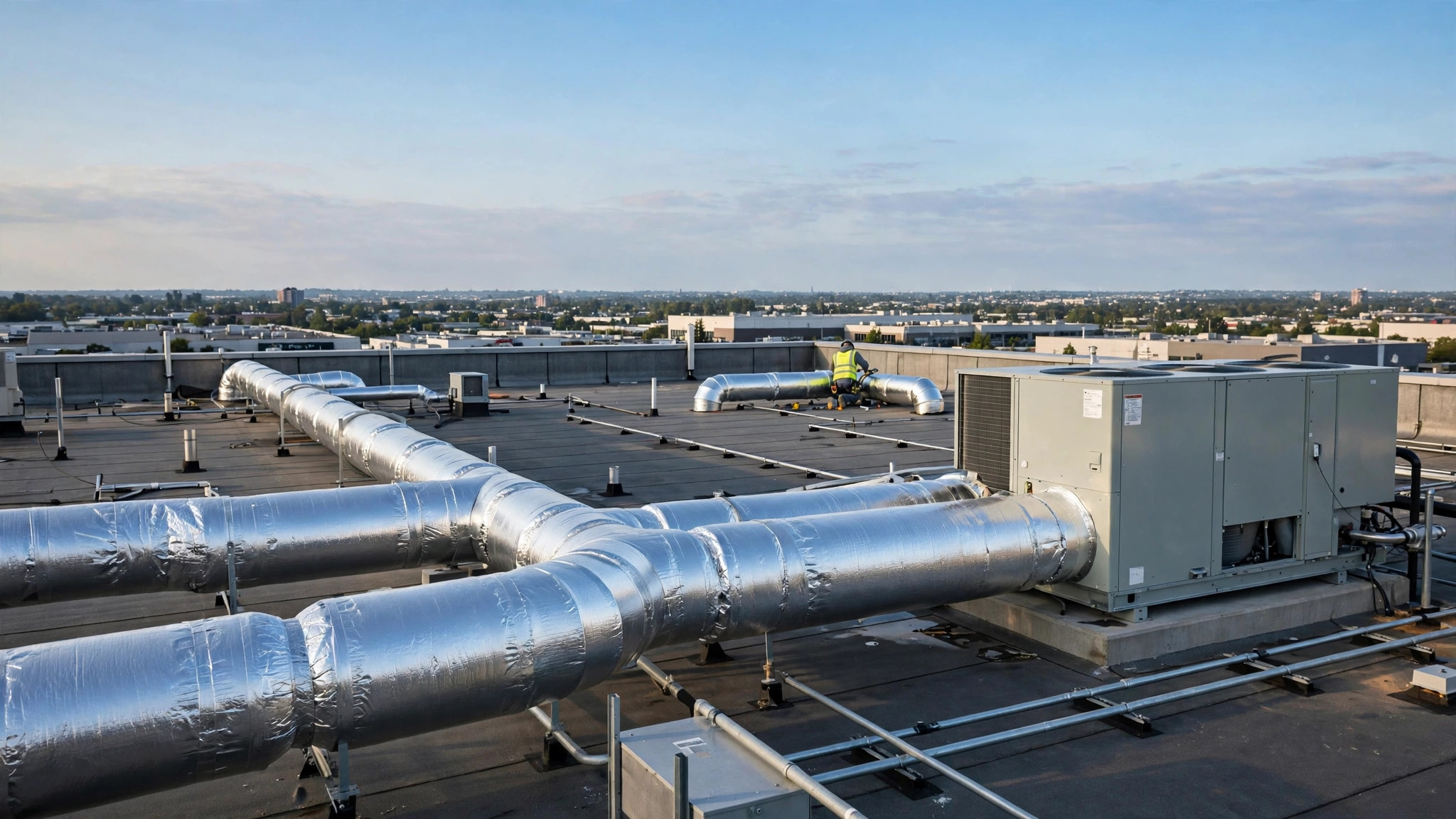
Ac ductwork replacement is the removal of old air conditioning ducts and installation of new ones in a commercial building. The ducts connected to your AC system carry cooled air to every room. When they leak, collapse, or grow mold, the AC runs harder, rooms stay warm, and bills climb. For building owners across the United States, ac ductwork replacement restores the cooling performance the equipment was designed to deliver.
AC ducts work under pressure every summer. Joints loosen, insulation degrades, and sections pull apart over years of thermal cycling. Because ducts hide above ceilings, the damage stays invisible while comfort slowly fades. This guide shows when replacement is the answer, what the project involves, and how to control the cost.
7 Signs You Need ac ductwork replacement
One, some rooms never cool down. When the AC runs constantly but certain zones stay warm, the ducts serving them may be crushed, disconnected, or undersized. A tech can measure airflow at the registers to confirm.
Two, energy bills keep rising. Leaky AC ducts dump cooled air into ceiling cavities and attics. The system compensates by running longer. If bills climb while rates and usage stay flat, duct losses are a prime suspect.
Three, weak airflow at vents. Hold your hand at a supply register. Weak flow with a healthy blower points to duct problems: blockages, collapses, or major leaks upstream. Compare flow across rooms to find the pattern.
Four, visible duct damage. Inspect accessible runs for crushed flex duct, torn insulation, rusted metal, disconnected joints, and water stains. Rooftop AC ductwork suffers sun and weather damage. What you can see is usually only part of the story.
Five, dust blowing from registers. Deteriorating duct interiors shed debris into the airstream. Old duct board can break down and release fibers. This hurts air quality and signals the ducts are past their prime.
Six, mold or musty smells when the AC runs. Moisture in ducts grows mold. Condensation from poor insulation or high humidity feeds it. Mold-damaged ducts usually need replacement, not just cleaning.
Seven, the AC was upgraded but ducts were not. A new high-efficiency unit connected to old leaky ducts cannot deliver its rated performance. Ac ductwork replacement alongside the equipment upgrade captures the full benefit.
What ac ductwork replacement Involves
Assessment starts the project. A contractor measures airflow at registers, runs a duct leakage test, and inspects accessible ducts. A load calculation confirms correct duct sizing for the building and the AC equipment. This data decides whether repair or full replacement is right.
Design follows. The contractor lays out new trunk lines, branches, register locations, and return paths. Good design fixes old errors: overly long flex runs, sharp bends, missing returns, and unbalanced zones. Fire and smoke dampers are placed per code.
Material selection balances cost and durability. Sheet metal is the commercial standard: tough, cleanable, long-lived. Fiberglass duct board costs less and self-insulates but is less durable. Flexible duct suits short final connections but should not run long distances. Most commercial jobs use sheet metal trunks with short flex branches.
Installation is the disruptive phase. Ceilings open, old ducts come out, new ducts go in. A good contractor phases work by zone, controls dust, and works off-hours where needed. Coordinate with tenants early and keep the schedule visible.
Testing and balancing finish the job. The contractor measures airflow at every register, checks total system airflow against design, tests for leaks, and sets dampers. You should receive a written report proving the system performs as designed.
Cost Factors for ac ductwork replacement
Building size sets the baseline. More area means more ductwork. But access matters as much as size: open ceilings cost far less per foot than ducts threaded above hard ceilings or through tight shafts.
Material choice moves the price. Sheet metal costs more than duct board but lasts longer and cleans better. Insulation on ducts in unconditioned spaces adds cost and is required for performance and code in many areas.
System complexity adds labor. Multi-zone systems with many branches, fire dampers, and controls take longer than a simple single-zone layout. Each damper and each custom fitting adds time.
Asbestos can appear in older buildings. Old duct insulation, sealants, and fireproofing may contain it. Testing is wise in pre-1980s buildings. If found, licensed abatement must precede the ductwork, adding cost and time.
Phasing and timing affect the total. Off-hours work costs more per hour but keeps the business running. A fast open-building project is cheaper than a slow phased one. Discuss the trade-off with your contractor.
For related costs, see commercial hvac repair cost. For equipment decisions, read ac repair vs replace commercial. For upkeep that protects ducts, see commercial hvac maintenance checklist.
Repair vs ac ductwork replacement
Choose repair for isolated damage. One crushed section, a single disconnected joint, or a short torn run can be fixed without replacing the system. If leakage tests show modest losses and the layout is sound, targeted repairs win.
Choose replacement for systemic problems. When leaks, damage, and sizing errors appear throughout, the patch bill over a few years exceeds one replacement project. A leakage test showing heavy losses across many runs is decisive.
Factor in age. Ducts past twenty-five years, especially duct board and flex, are near end of life. Metal ducts last longer but still degrade. If the AC unit is also aging, replacing both together saves on mobilization and ensures a matched system.
Consider contamination. Mold throughout the system, heavy pest damage, or crumbling lining will not be solved by cleaning. Replacement gives a clean start with modern materials and proper insulation.
Choosing the Right Contractor
Commercial experience is essential. Ask how many commercial duct projects the company completes yearly. Commercial work involves larger ducts, fire dampers, mechanical codes, and coordination with other trades. Residential duct installers may not be ready.
Demand a design with the bid. Duct sizes, layout drawings, materials, insulation R-values, and design airflow per zone should be specified. A lump-sum bid with no design detail cannot be compared fairly.
Check licenses, insurance, and code knowledge. Ductwork affects fire safety through dampers and shaft penetrations. The contractor should pull permits and know local mechanical codes. Verify insurance before work begins.
Ask for commercial references and call them. Ask about disruption control, schedule keeping, dust management, and whether comfort actually improved. The only good duct job is one where the building feels better.
Agree on acceptance testing in the contract. Airflow measurements, leakage testing, and balancing reports should be contract requirements, not favors. Numbers prove the job.
After ac ductwork replacement
Inspect with the contractor before final payment. Verify register locations, damper access, insulation integrity, and cleanup. Collect the test and balance report with airflow readings for your records.
Start filter maintenance immediately. New ducts stay clean with clean filters. Check filters monthly at first to learn the loading rate in your building. Good filtration protects both the ducts and the AC equipment.
Seal the building envelope where practical. New ducts perform best in a reasonably tight building. Weatherstripping doors and sealing obvious leaks helps the system hold temperature with less run time.
Monitor the first cooling season. Note whether warm spots are gone and whether energy bills drop compared to prior years. If a zone still underperforms, call the contractor back under warranty for balance tweaks.
Keep the documentation. File the design drawings, test reports, equipment specs, and invoices together. Future service techs will work faster with this history, and the records support warranty or insurance questions.
The Department of Energy offers duct efficiency guidance for commercial buildings at https://www.energy.gov/. ENERGY STAR resources for building upgrades are at https://www.energystar.gov/.
Deciding on ac ductwork replacement should start with measured data: airflow readings and a leakage test, not guesses. A good ac ductwork replacement design fixes old layout mistakes like long flex runs and missing returns. During ac ductwork replacement, dust control and phased scheduling keep the business running. The cost of ac ductwork replacement depends heavily on access, so open ceilings save real money. After ac ductwork replacement, the test-and-balance report proves the system performs as designed. Keep that report, because the next ac ductwork replacement, decades away, will go smoother with full documentation.
How long does ac ductwork replacement take?
Small commercial spaces may take several days. Large multi-zone buildings can take weeks, especially with phased work around occupants. Get a written schedule from your contractor.
Will new ducts lower my cooling bills?
If the old ducts leaked badly, yes, often noticeably. Sealed, properly sized ducts deliver the air where it belongs, so the AC runs less. The worse the old leaks, the bigger the saving.
Can ducts be replaced without replacing the AC unit?
Yes, when the existing unit is in good condition and correctly sized. But if the unit is also old, doing both together is usually cheaper overall and guarantees a matched system.
How long do new AC ducts last?
Sheet metal ducts often last thirty years or more with maintenance. Duct board and flex last less. Clean filters, prompt leak repairs, and dry conditions extend any duct system.
Is ac ductwork replacement messy?
It can be. Opening ceilings creates dust and noise. Professional contractors use dust barriers, negative air, and daily cleanup, and can work off-hours. Discuss the plan before signing.
Next Steps
Get a professional duct assessment with airflow measurements and a leakage test. The numbers will tell you whether repair or ac ductwork replacement is the right call. Collect three detailed bids with designs, schedule the work to minimize disruption, require completion testing, and file the reports. New ducts are an invisible upgrade with very visible comfort and cost results.



