
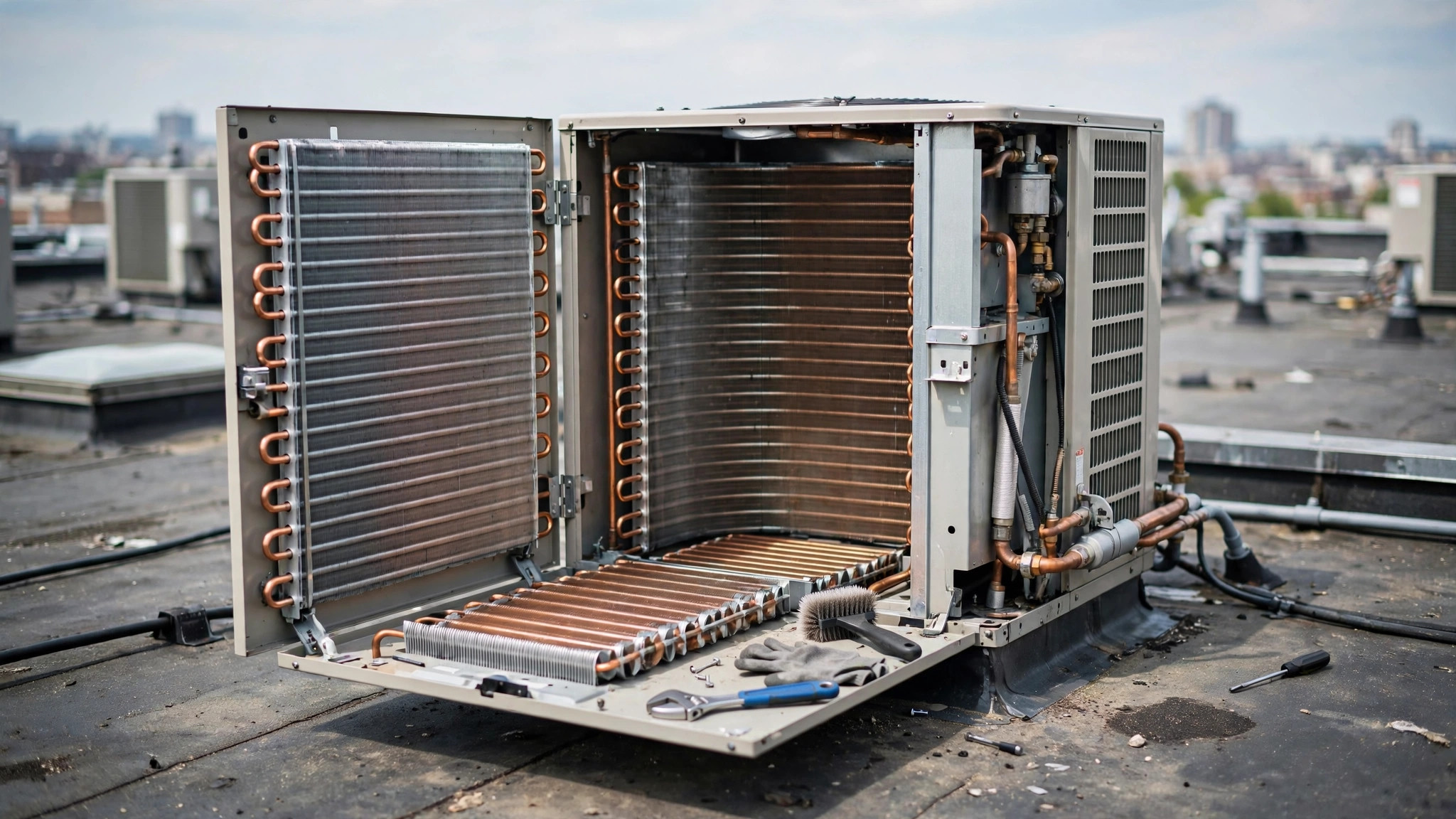
Tenants are calling. The office is warm. The unit on the roof is making a noise it never made before. You need commercial air conditioner repair, and you need it fast, but not at any price. This guide explains the nine problems that cause most service calls, what fair repairs cost, and how to hire a crew that fixes it right the first time.
Commercial systems are not big residential units. Rooftop package units, split systems, and chillers serve large zones with complex controls. Bad commercial air conditioner repair wastes energy, shortens equipment life, and brings the same complaint back next month. Good repair starts with real diagnosis. Learn what that looks like below.
Commercial air conditioner repair Starts With Diagnosis
A good tech does not guess. They check airflow first, then refrigerant, then electrical, then controls. They measure superheat and subcooling. They read the control board codes. They inspect the ductwork and filters. This takes time. A firm that quotes a compressor replacement over the phone is selling, not diagnosing.
Ask what they found and why it failed. A failed capacitor is a part. A failed capacitor plus a dirty condenser coil is a story. The second answer shows real commercial air conditioner repair. It fixes the cause, not just the symptom. Get the diagnosis in writing before you approve the work.
9 Common Problems in commercial air conditioner repair
These nine cover most calls.
- Dirty or clogged filters. Restricted airflow freezes coils and starves zones. The cheapest fix and the most ignored.
- Failed capacitors or contactors. Electrical parts wear out. The unit hums but never starts, or starts and dies.
- Refrigerant leaks. Low charge cuts cooling capacity. The leak must be found and sealed, not just topped off.
- Dirty condenser or evaporator coils. Dirt blocks heat transfer. The system runs longer and cools less.
- Failed fan motors. No airflow means no cooling. Bearings and belts give warning signs before they quit.
- Faulty thermostats and sensors. Bad readings cause short cycling or zones that never reach setpoint.
- Control board failures. Modern units depend on electronics. Power surges and heat kill boards.
- Drainage clogs. Condensate lines back up. Water damages ceilings and shuts the unit down on float switches.
- Duct leaks and damage. Cool air escapes into ceiling spaces. Zones stay warm while the unit runs flat out.
- Licensed HVAC contractor with commercial experience, verified by phone.
- Techs certified for your refrigerant type.
- Written diagnosis with measurements, not just a part name.
- Clear parts and labor breakdown on the quote.
- Warranty on parts and labor stated in writing.
- References from buildings like yours you can call.
Know these nine and you can talk to any tech with confidence. In commercial air conditioner repair, naming the symptom and its likely cause gets you faster, fairer quotes.
Real Price Ranges
Numbers help. Minor commercial air conditioner repair, like a capacitor, contactor, or thermostat swap, runs 200 to 600 dollars. Mid-range work, like a fan motor or control board, runs 600 to 1,500 dollars. Major work, like a compressor replacement or leak repair with recharge, runs 1,500 to 4,000 dollars or more.
Refrigerant type affects the bill. Older refrigerants cost far more per pound. Ask which refrigerant your system uses and its current price. Get three quotes on any job over 1,000 dollars. If all three cluster together, that is your market price. If one is far off, ask why.
The 6-Point Hiring Checklist
Use this before anyone touches your unit.
Ask how they will confirm the fix. A pressure test after a leak repair. A temperature split check after a coil cleaning. Real commercial air conditioner repair ends with proof, not promises. The [Air Conditioning Contractors of America](https://www.acca.org/) offers consumer guides worth reading before you hire.
Watch how the tech works. Do they take readings before and after? Do they explain the numbers? Do they clean up the work area? These habits signal pride in the craft. Sloppy habits signal sloppy repairs. You are hiring judgment as much as labor. Trust the crew that measures twice.
Refrigerant: What Owners Must Know
Refrigerant law affects every commercial air conditioner repair. Older refrigerants are phased down. Prices rise. Topping off a leaking system without sealing the leak is illegal in many cases and always wasteful. A good tech finds the leak with a detector or dye, repairs it, then charges to spec.
Ask for the leak location in writing. Ask how much refrigerant was added and its cost per pound. Keep these records. If the same unit leaks again next season, the records tell you whether the last fix failed or a new leak started. [ENERGY STAR](https://www.energystar.gov/) publishes guidance on efficient cooling equipment for commercial buildings.
Older systems using phased-out refrigerants face rising costs and shrinking supply. A leak on such a unit deserves a frank talk about replacement. The tech should explain the refrigerant type, its availability, and the trend in price. If the charge costs hundreds per pound and the unit leaks yearly, the math points toward a new system. Ask for that comparison in writing before authorizing another recharge.
Preventive Care That Prevents Calls
Most commercial air conditioner repair calls are preventable. Change or clean filters on schedule. Keep condenser coils clean and clear of debris. Check belts and bearings each season. Keep condensate drains clear. Calibrate thermostats yearly.
A maintenance agreement covers these tasks. A tech visits two to four times a year, inspects, cleans, and reports problems early. The cost is small next to one emergency call. Ask what the plan covers. Get it in writing. Buildings with service plans see fewer breakdowns and lower energy bills. Ask the firm to show you their visit checklist before you sign. It should cover filters, coils, refrigerant, electrical, drains, and controls. If the list is thin, the visits will be thin too.
When Repair Becomes Replacement
Sometimes repair is the wrong call. If the unit is over 15 years old, uses phased-out refrigerant, and needs a major component, compare repair cost against replacement. A common rule: if the repair costs more than half the price of a new unit, replace it.
New units bring better efficiency. Lower energy bills offset the purchase over time. Ask for a side-by-side comparison: repair cost and expected life versus replacement cost and projected savings. Honest commercial air conditioner repair firms give you both options. Sales-only firms push replacement every time.
Reading Your Technician's Report
After any commercial air conditioner repair, you should get a written report. Learn to read it. Look for measured numbers: supply and return temperatures, refrigerant pressures, superheat and subcooling values, and amp draws on motors. These numbers prove the system runs to spec. A report with no numbers is a guess with a signature.
Compare reports over time. Rising amp draws signal wearing motors. Falling temperature split signals dirty coils or low charge. Ask the tech to explain any number that moved since the last visit. Techs respect owners who read. The habit turns every service call into a small audit. Keep the reports in your equipment file. They are the history that future decisions rest on.
Related Reading
For broader HVAC help, see [commercial hvac repair](/commercial-hvac-repair/). For AC-specific service plans, read [commercial ac repair](/commercial-ac-repair/). For keeping systems healthy, see [commercial ac maintenance](/commercial-ac-maintenance/) when it publishes.
FAQ
How fast should commercial air conditioner repair happen?
Same-day service matters when tenants or inventory are at risk. For a single zone down, next-day is often fine. Ask the firm for a realistic window and hold them to it. Emergency rates apply after hours.
Why does my unit keep freezing up?
Low airflow or low refrigerant are the usual causes. Dirty filters, blocked coils, or a slow leak all freeze the evaporator. A tech must find the cause. Just thawing it guarantees a repeat call.
Is topping off refrigerant a real fix?
No. It is a temporary patch. The leak continues. Proper commercial air conditioner repair finds and seals the leak, then charges the system to spec. Repeated top-offs cost more than one real fix.
How long should a repair last?
Minor parts should last years. A compressor replacement should give five to ten more years of service. Ask the firm for the expected life of each repair in writing.
Can I use a residential HVAC tech for my building?
Not for commercial systems. Rooftop units, controls, and refrigerant rules differ. Hire a licensed commercial HVAC contractor. The wrong tech can void warranties and miss real faults.
Next Steps
Check your filters this week. Walk the roof and look at the units. Note any noise, rust, or water stains. Call three commercial HVAC firms and compare their maintenance plans. Fix small faults now, before peak season. Smart commercial air conditioner repair starts with attention, not emergencies. Act while the system still runs. Log every service visit with dates and parts replaced. A complete history helps the next technician diagnose faster.



