
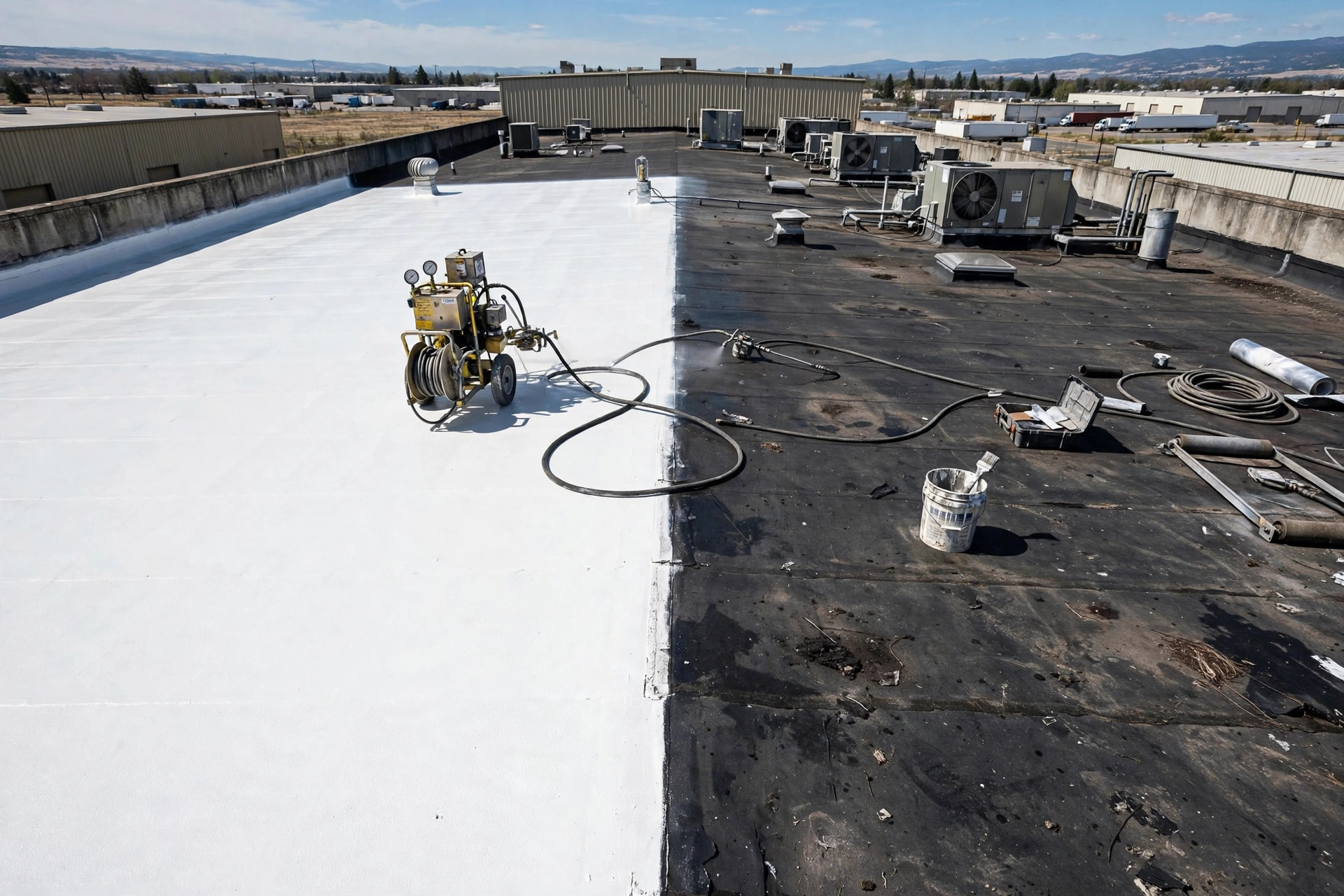
A roof replacement is one of the biggest checks a building owner writes. Commercial roof coatings offer a way to delay it: liquid systems applied to the existing roof that seal, protect, and reflect. The right coating on the right roof buys ten to twenty more years for a fraction of replacement cost.
This guide compares the seven main commercial roof coatings, explains what each does best, and shows how to pick the right one for your building.
What commercial roof coatings do
Every coating does three jobs. It waterproofs by forming a seamless skin over the old roof. It protects by shielding the old membrane from sun and weather. And most coatings reflect sunlight, which cuts cooling costs. Together, those three jobs extend the roof’s service life at a fraction of replacement cost.
Coatings work on many existing roofs: single-ply membranes, modified bitumen, built-up roofing, metal, and spray foam. The old roof must be sound and dry. Coatings seal aging, not failure. A roof that is falling apart needs replacement, not paint.
The application is straightforward. Crews clean and repair the old roof, prime where needed, and apply the coating by spray, roller, or brush, usually in two coats. The result has no seams to split. That seamless quality is the core advantage of commercial roof coatings over patch repairs.
The 7 types of commercial roof coatings
- Acrylic. The most common and affordable. Water-based, reflective, and easy to apply. Best on roofs that drain well. Weak against long-term ponding water.
- Silicone. The ponding-water champion. Shrugs off standing water that destroys acrylic. Costs more per gallon and needs thicker application. The pick for low-slope roofs with slow drainage.
- Polyurethane. Tough and traffic-resistant. Aromatic versions need a UV top coat. Aliphatic versions stand alone in the sun. Good where foot traffic is heavy.
- Asphalt-based. The budget option for old built-up and modified bitumen roofs. Extends life cheaply with little reflectivity. A few more years at the lowest price.
- Butyl rubber. Excellent waterproofing with strong adhesion. Often used for repairs and flashings within larger coating jobs. Niche but effective.
- Polyurea. Fast-curing and extremely tough. Applied by specialists with plural-component spray rigs. Premium price for premium performance on demanding roofs.
- Fluoropolymer top coats. The longest-lasting reflective finish. Often applied over other coatings to extend their life. Premium cost, premium longevity.
The National Roofing Contractors Association covers coating systems for owners at https://www.nrca.net/. The U.S. Department of Energy explains reflective coating energy benefits at https://www.energy.gov/.
Comparing commercial roof coatings on cost
Acrylic jobs usually cost the least installed. Silicone runs higher because the material costs more and goes on thicker. Polyurethane and polyurea run higher still, driven by material price and specialist application. Asphalt-based coatings are cheapest but shortest-lived.
Prep work swings every bid. A clean roof with sound seams needs little prep. A dirty roof with blisters and bad flashing needs days of repair first. When you compare commercial roof coatings, compare the prep line item by item. The product price means little without the prep price.
Think in cost per year of extended life. A cheap coating that lasts ten years can beat an expensive one that lasts twelve on yearly cost, or lose to it. Ask each bidder for the expected life and the recoat schedule, then divide. The yearly number is the honest comparison.
Energy savings count too. White reflective commercial roof coatings cut cooling costs in hot climates every summer. Some utilities offer rebates. Factor the savings and any rebate into the comparison.
Choosing among commercial roof coatings
Start with the roof you have. Single-ply membranes take acrylic, silicone, and urethane well. Metal roofs need coatings with strong adhesion and rust treatment first. Old built-up roofs suit asphalt-based or acrylic systems. Foam roofs need compatible coatings that will not attack the foam. Match the product to the substrate.
Then look at drainage. Good drainage opens every option. Ponding water narrows the field to silicone and a few others. Be honest about the ponds. Coating salesmen sometimes promise their product handles ponding when it does not. Check the data sheet yourself.
Consider foot traffic. Roofs with frequent service visits need tougher coatings or walk pads. Soft coatings tear under work boots. If technicians cross the roof weekly, say so during bidding. The right of the commercial roof coatings for a quiet roof is wrong for a busy one.
Check the warranty terms. Length, coverage, exclusions, and the recoat requirement all matter. A twenty-year warranty that demands a recoat at year ten is really two purchases. Know that going in.
Commercial roof coatings vs replacement: the decision math
Run both numbers before you decide. Get a coating quote and a replacement quote for the same building. Divide each by its expected service life. A coating at a third of the replacement price lasting half as long wins on yearly cost. But if the roof needs coating twice to match one replacement’s life, the math gets close. Do not assume. Calculate.
Consider the building’s horizon. Selling in five years? A coating with a transferable warranty is clean and cheap. Holding for thirty? Compare two coating cycles against one replacement, including the disruption each brings. Replacement disrupts once and lasts decades. Coating disrupts less each time but comes around again.
Factor the unknowns. Replacement lets the contractor see the deck and fix hidden damage. Coating leaves the old roof in place, problems and all. If the roof’s history suggests hidden trouble, replacement’s higher price buys certainty. When owners weigh commercial roof coatings against tear-off, certainty has a value worth pricing.
Drainage can tip the scale. A roof with bad ponding needs drainage work either way. Tapered insulation during a replacement fixes it permanently. Coating over ponds shortens the coating’s life. Price the drainage fix into both options and compare honestly.
Maintaining a coated roof
A coated roof is low maintenance, not no maintenance. Inspect it twice a year and after big storms. Look for new punctures, peeling at edges, and damage around rooftop equipment. Small problems fixed fast stay small. The seamless skin only works while it is whole.
Keep the drains clear. Ponding water tests every coating, even silicone. Leaves and trash block drains slowly, and the pond grows a little each storm. A quarterly drain check takes minutes and protects the whole investment.
Wash the roof occasionally in dusty areas. Dirt dulls reflectivity and hides developing problems. A light washing restores the cooling benefit and lets the inspector see the surface clearly. Do not use harsh chemicals or high pressure that could damage the coating.
Schedule the recoat before the warranty demands it. Mark the date when the job finishes. A recoat done on time costs less than one done late, because the prep stays light. Owners who recoat on schedule get the full rated life. Owners who forget learn what the warranty exclusions mean.
Commercial roof coatings: a project checklist
- Moisture survey proving the old roof is dry.
- Code check: coating allowed over the existing system.
- Product matched to the roof substrate and drainage.
- Required dry thickness in mils, in the contract.
- Full prep scope: washing, repairs, flashing, priming.
- Overspray protection plan for equipment and surroundings.
- Application method and crew experience with the product.
- Thickness verification method during the job.
- Warranty terms, exclusions, and recoat schedule in writing.
- References from similar coated roofs, checked by phone.
For applicator selection, see commercial roof coating contractors. For metal roof specifics, see commercial metal roof restoration. For flat roof context, see commercial flat roof repair.
Questions owners ask about commercial roof coatings
How long do commercial roof coatings last?
Ten to twenty years depending on the product and the recoat schedule. Premium systems last longer. Skipped recoats shorten every system. The warranty tells you the maker’s honest expectation.
Can coatings fix leaks?
Small ones on sound roofs, yes. Leaks from wet insulation, structural movement, or failed flashing need real repair first. Coatings seal surfaces. They do not rebuild structures.
Do I need to recoat?
Most systems do, on the maker’s schedule. The recoat is cheaper than the first job because the prep is lighter. Budget for it from day one. It is part of the system, not an extra.
Will a coating lower my cooling bills?
A white reflective coating can cut summer cooling costs noticeably in hot climates. The savings are smaller in mild climates. Either way, waterproofing and extended life are the main value. Energy is the bonus.
What voids a coating warranty?
Wrong thickness, skipped prep, ponding beyond the product’s rating, and missed recoats are the usual killers. Read the exclusions before you buy. The Occupational Safety and Health Administration covers fall protection for the crews at https://www.osha.gov/.
Your next steps
Get the moisture survey first. Then match two or three of the commercial roof coatings to your roof type, drainage, and traffic. Get bids that spell out prep, product, thickness, and warranty. The right coating buys you a decade or more. The wrong one buys a lesson. Choose with the data sheet in hand.



