
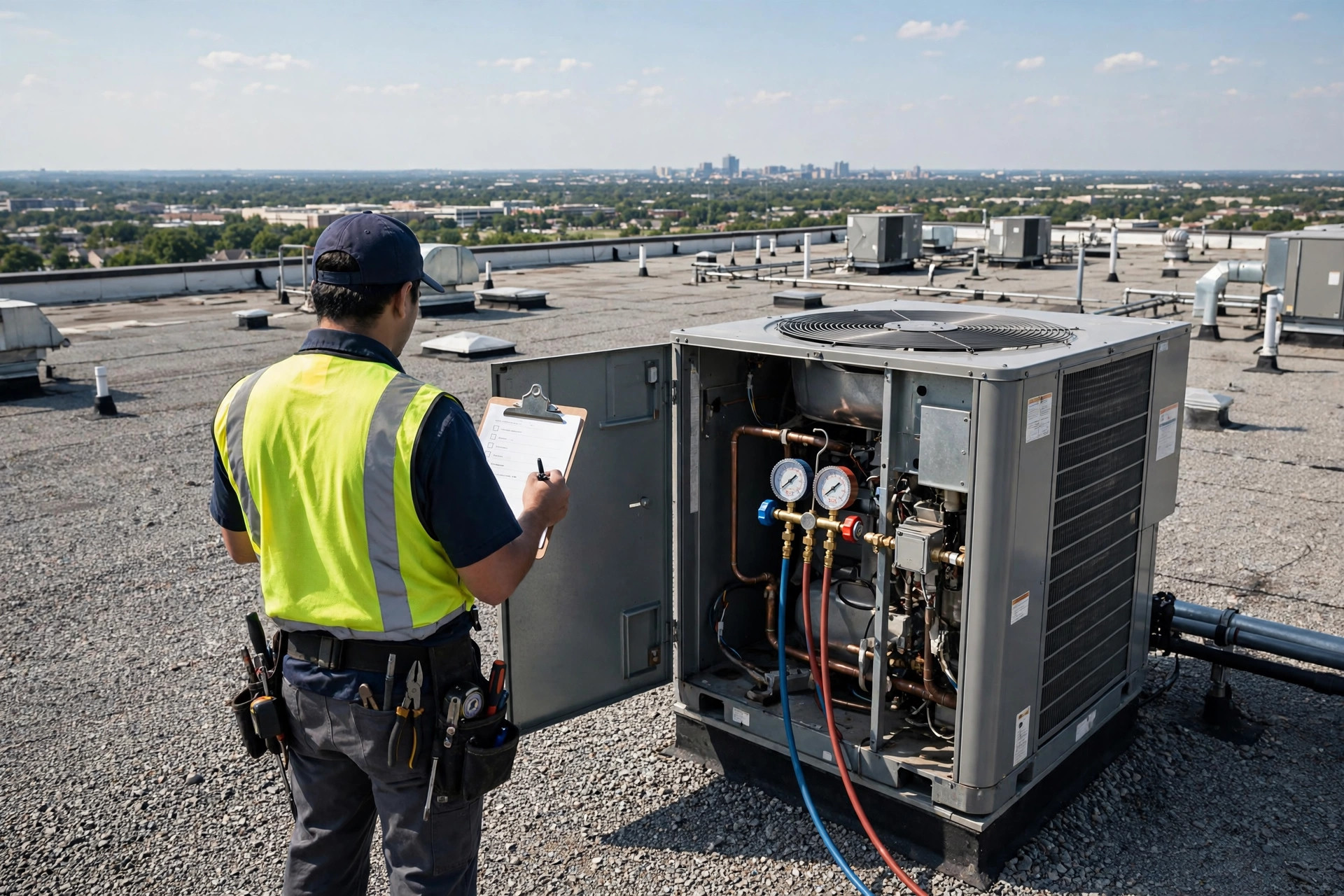
Commercial HVAC preventative maintenance is the scheduled care that keeps heating, cooling, and ventilation equipment from breaking down. Instead of waiting for failures, the building follows a 12-month plan of inspections, cleanings, and tune-ups. Commercial HVAC preventative maintenance catches worn parts, dirty coils, and control drift before they cause outages.
The payoff is large. Well-maintained systems use less energy, last longer, and break down far less often. Many manufacturer warranties require documented preventative care. This guide lays out a practical 12-month plan for commercial hvac preventative maintenance, the task lists by season, the cost factors, and answers to the questions owners ask most.
Why Commercial HVAC Preventative Maintenance Matters
Every hour of downtime costs a commercial building money. Staff sit idle, customers leave, and stock can spoil. Emergency repairs cost more than planned visits and often happen at the worst times. Commercial HVAC preventative maintenance shifts the spending from crisis to plan.
Energy savings add up too. Dirty coils, low refrigerant, and stuck dampers waste energy all year. The US Department of Energy notes that neglected systems can waste a large share of the energy they use. Their commercial building resources at energy.gov show how steady upkeep cuts utility bills. ASHRAE publishes maintenance standards for commercial systems at ashrae.org.
There is also the equipment life factor. A rooftop unit on a preventative plan often serves years longer than a neglected one. Fewer replacements mean lower capital spending over time. For most buildings, commercial hvac preventative maintenance is the highest-return service they buy.
The 12-Month Commercial HVAC Preventative Maintenance Schedule
A full year of commercial hvac preventative maintenance follows the seasons. Here is a practical schedule.
Spring: cooling startup. Clean condenser coils, check refrigerant charge, test capacitors and contactors, inspect belts and bearings, clear condensate drains, and calibrate thermostats. Start the cooling systems and verify each zone cools properly.
Summer: mid-season check. Inspect filters, check refrigerant pressures, clean coils again if the environment is dusty, verify economizer operation, and review energy use for anomalies. Catch the problems that heat exposes.
Fall: heating startup. Clean burners and heat exchangers, check gas pressure and ignition, test safety controls, inspect flues and vents, lubricate motors, and verify heating zones. Start the heating systems before cold weather arrives.
Winter: mid-season check. Inspect filters, check for unusual noises or smells, verify controls and schedules, test safety devices, and review fuel use. Cold weather exposes weak parts fast.
Between these seasonal visits, building staff handle monthly filter checks and keep outdoor units clear of debris. Write the whole schedule into the building calendar with named responsibilities. For a detailed task model, see commercial HVAC maintenance checklist.
Core Tasks in Every Commercial HVAC Preventative Maintenance Visit
Whatever the season, these tasks belong in commercial hvac preventative maintenance:
- Change or clean air filters.
- Clean condenser and evaporator coils.
- Check refrigerant levels and inspect for leaks.
- Tighten electrical connections and test voltage.
- Inspect belts, bearings, and motors.
- Clear condensate drains and pans.
- Test thermostats, sensors, and schedules.
- Inspect ductwork connections for leaks.
- Check rooftop unit housings, curbs, and seals.
- Test safety controls and economizers.
- Record measurements for the equipment history.
- Report recommended repairs with priorities.
A visit that skips these basics is not real preventative maintenance. Ask the provider for their checklist and compare it with this list.
Commercial HVAC Preventative Maintenance Cost Factors
Use this checklist to understand pricing.
- Number and size of units. More units and larger tonnage raise the annual cost.
- Visit frequency. Quarterly plans cost more per year than twice-yearly plans.
- System complexity. Automation, chillers, and boilers need more skilled labor.
- Environment. Dusty or corrosive settings need more frequent care.
- Equipment age. Older systems take longer to service.
- Filter grade. High-efficiency filters cost more per change.
- Contract terms. Annual agreements usually beat per-visit pricing.
Compare the agreement cost against one avoided emergency repair. The math almost always favors prevention. For help choosing a provider, see commercial HVAC service.
Tracking Results from Commercial HVAC Preventative Maintenance
A plan without measurement is just spending. Keep a log for each unit: visit dates, tasks done, parts replaced, and readings like refrigerant pressures and amp draws. Add monthly energy use from utility bills.
Review the log with the provider at least once a year. Look for trends: rising repair costs on one unit, repeated failures of the same part, or energy use that will not come down. These patterns guide replacement planning and prove the value of commercial hvac preventative maintenance to anyone who questions the budget.
The log also protects warranty claims. Manufacturers that require documented maintenance will ask for these records. A building with complete logs gets claims approved faster.
Common Failures Prevented by Commercial HVAC Preventative Maintenance
It helps to know what the plan actually prevents. These are the breakdowns that commercial hvac preventative maintenance stops most often.
Compressor failure. The costliest single failure in cooling equipment. Low refrigerant, dirty coils, and bad capacitors kill compressors. Regular checks catch all three early. A compressor replacement can cost many times the annual maintenance budget.
Heat exchanger cracks. On gas heating equipment, neglected burners and restricted airflow overheat the heat exchanger until it cracks. Annual cleaning and airflow checks prevent this dangerous failure.
Motor and bearing seizures. Bearings that never get lubricated and belts that never get replaced eventually take down motors and fans. These are cheap parts with expensive consequences when ignored.
Refrigerant leaks. Small leaks grow over time. Left alone, they lead to poor cooling, frozen coils, and compressor damage. Leak checks during commercial hvac preventative maintenance find them while they are still small.
Control failures. Sensors drift, thermostats die, and automation glitches waste energy for months unnoticed. Calibration and testing during visits keep controls honest.
Drain floods. Clogged condensate drains back water into ceilings and equipment. Flushing drains each visit prevents some of the messiest and most expensive HVAC failures.
Every one of these starts small and ends big. The plan exists to catch them at the small stage.
Getting Staff Buy-In for Commercial HVAC Preventative Maintenance
The best plan fails if building staff ignore it. Make the plan visible and simple. Post the schedule where maintenance staff see it daily. Assign each task to a named person, not to “someone.”
Train staff on the basics: how to check a filter, what a normal unit sounds like, and what to report. Give them a simple reporting path, such as a shared log or a quick message to the manager. Praise quick reporting. Staff who get thanked for flagging a strange noise will flag the next one too.
Review the plan with the team twice a year. Show them the energy trends and the repair history. When staff see that commercial hvac preventative maintenance actually cuts breakdowns, they take ownership of their part. A plan the team believes in beats a perfect plan nobody follows.
Commercial HVAC Preventative Maintenance FAQs
How often should preventative maintenance be done?
At minimum twice a year, before the cooling and heating seasons. Heavy-use or harsh-environment buildings do better with quarterly visits. Monthly filter checks by staff fill the gaps.
What is the difference between preventative and predictive maintenance?
Preventative maintenance follows a set schedule of tasks. Predictive maintenance uses sensors and data to forecast failures before they happen. Many buildings combine both: scheduled care plus monitoring of critical equipment.
Can in-house staff do commercial hvac preventative maintenance?
Staff can handle filters, visual checks, and keeping units clear. Refrigerant work, electrical testing, gas systems, and rooftop safety belong to licensed technicians. A mix of both keeps costs down without taking risks.
Does preventative maintenance really save money?
Yes. Fewer emergency calls, lower energy bills, longer equipment life, and protected warranties add up to savings well beyond the plan cost. Most owners see the return within the first year.
What should I look for in a maintenance provider?
Commercial experience with your equipment type, proper licensing and insurance, a detailed written checklist, clear reporting, and priority emergency response. Check references from similar buildings before signing.
Next Steps for Building Owners
Commercial HVAC preventative maintenance turns breakdown roulette into a managed plan. Put the 12-month schedule in writing with a qualified provider, assign the staff tasks, and keep the logs. Review results yearly and adjust the plan as equipment ages. Steady prevention keeps the air right, the bills down, and the equipment running for years. Start by listing every unit in the building with its age and condition. Then get two or three written proposals from qualified providers and compare their checklists task by task. Sign with the firm that shows the strongest plan, not just the lowest price, and hold them to it with the logs. Review the results together each year and refine the schedule. Prevention is a habit, and habits compound into real savings. Buildings that commit to the plan rarely regret it. Start this season. Today.



