
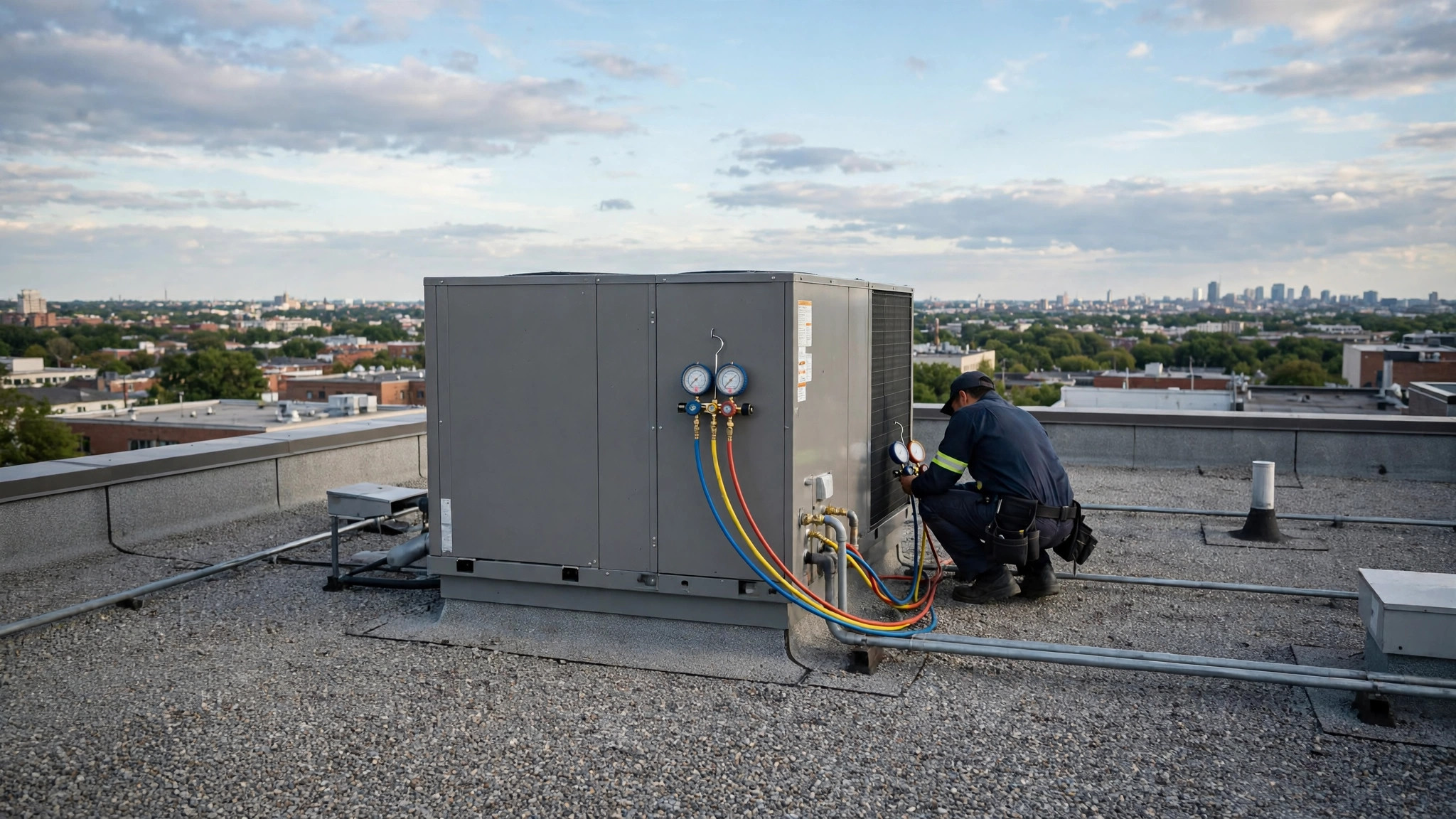
Every commercial building has an HVAC system. Few owners have a plan for it. They call when it breaks, pay emergency rates, and repeat the cycle. There is a better way. A commercial hvac service plan puts your heating and cooling on a schedule, with a provider who knows your equipment by name.
This guide explains commercial hvac service in plain terms. You will learn what a service plan includes, seven benefits it delivers, what the contract should cover, and how to compare providers. If your building runs without a plan today, this is the article that changes that.
What commercial hvac service Includes
Commercial hvac service is scheduled professional care for your building’s heating, ventilation, and air conditioning systems. It is maintenance, not just repair. The provider visits on a set schedule, inspects and tunes the equipment, fixes small faults before they grow, and documents everything.
A typical plan covers rooftop units, split systems, boilers, furnaces, ventilation equipment, and controls. Each visit follows a checklist: filters, coils, belts, bearings, refrigerant levels, electrical connections, controls calibration, and safety testing on gas equipment. The tech leaves a written report with readings and recommendations.
This differs from on-call repair in one big way. On-call work reacts to failure. Commercial hvac service prevents it. The provider learns your equipment over time: its quirks, its weak points, its history. When something fails at midnight, the on-call tech already knows what they are walking into.
Plans come in tiers. Basic plans cover inspections and minor adjustments. Mid-tier plans add priority response and discounts on parts and labor. Full-coverage plans include most repairs for a flat fee. The right tier depends on your equipment age, your tolerance for surprise bills, and your budget.
7 Benefits of a commercial hvac service Plan
Here is what a good plan buys you.
- Fewer breakdowns. Regular inspection catches worn belts, dirty coils, and weak capacitors before they fail. Most emergency calls trace back to faults a scheduled visit would have found.
- Lower energy bills. Clean coils, correct refrigerant charge, and calibrated controls cut waste. A neglected system can cost far more to run than a maintained one. The savings often offset much of the plan price.
- Longer equipment life. Systems that get regular care last noticeably longer than neglected ones. Delaying a replacement by even a few seasons is a major financial win.
- Priority response. Plan customers jump the queue during heat waves and cold snaps. When every building calls at once, the provider serves contract customers first. That priority is worth real money.
- Predictable costs. A flat plan fee replaces surprise repair bills. Budgeting gets simple. Your finance people will thank you.
- Documented history. Every visit adds to your equipment file: readings, parts, recommendations. This history supports warranty claims, helps with insurance, and informs replace-versus-repair decisions.
- Safety compliance. Gas equipment gets combustion testing. Electrical gets inspected. Ventilation gets verified. Regular commercial hvac service keeps your building on the right side of codes and standards.
Seven benefits, one contract. That is the value proposition in a sentence.
What a commercial hvac service Contract Should Cover
Read the contract before you sign. Here is what belongs in it.
The equipment list comes first. Every unit covered should be named with its location, type, and serial number. If a unit is not listed, it is not covered. Walk the building with the provider and confirm the list matches reality.
The visit schedule comes second. How many visits, and in which seasons? What happens at each visit? The contract should spell out the checklist or attach it. Vague promises of “regular maintenance” mean nothing. Specific tasks mean everything.
The response guarantee comes third. What is the promised response time for emergency calls? Four hours? Eight? Get the number in writing. Ask what happens if they miss it. A guarantee without a remedy is a wish.
Pricing terms come fourth. What is included in the flat fee? What costs extra? Most plans exclude major parts and refrigerant. That is normal. What matters is the discount you get on extras and a clear price list for common repairs.
The term and renewal come fifth. How long is the agreement? How does it renew? What is the cancellation notice? Avoid contracts that lock you in with no exit. A provider confident in their work does not need a trap.
Exclusions deserve their own read. Normal wear parts, acts of nature, damage by other trades: know what sits outside the plan. A commercial hvac service contract should be boring to read and clear to understand. Confusion favors the writer, not you.
Comparing commercial hvac service Providers
Plans differ. Providers differ more. Compare them on these points.
Start with the checklist. Ask each bidder for their standard visit checklist in writing. Compare task by task. One provider’s “full service” is another’s quick look. The detailed checklist usually wins.
Check the reporting. Ask to see a sample visit report. Good reports show readings, findings, and recommendations. Thin reports show a date and a signature. You are buying the documentation as much as the labor.
Verify the team. Who does the visits: seasoned techs or rotating trainees? Ask for the lead tech’s name and credentials. NATE certification and factory training on your brands are plus marks. A commercial hvac service plan is only as good as the person holding the gauges.
Test responsiveness before you sign. Call their dispatch line with a question. Time the callback. The pre-sale experience predicts the post-sale experience with remarkable accuracy.
Ask about parts sourcing. Do they stock common parts for your equipment? How long does an unusual part take? A provider with a stocked truck and local supply relationships restores you faster.
Compare the math honestly. Add the plan fee to your expected extra costs under each bid. The cheapest plan with the thinnest coverage and the smallest discounts often costs the most by the end of the term. Total cost of the relationship is the number that matters.
The [ENERGY STAR program](https://www.energystar.gov/buildings) offers tools for tracking building energy performance. [ASHRAE](https://www.ashrae.org/) publishes the maintenance standards behind good commercial practice. The [Department of Energy](https://www.energy.gov/energysaver/heat-and-cool/heat-pump-systems) covers system efficiency basics worth knowing.
Warning Signs in a Bad Contract
Some contracts deserve a red pen or a rejection.
Watch for auto-renewal with short cancellation windows. A contract that renews for a full term unless you cancel within ten days of expiry is designed to trap you. Ask for plain renewal terms.
Watch for vague scope. “Maintain HVAC equipment” with no checklist, no visit count, and no equipment list is not a contract. It is a subscription to whatever they feel like doing.
Watch for exclusion creep. If the exclusion list is longer than the inclusion list, the plan covers little. Ask the provider to walk you through a real breakdown scenario and show what the plan pays.
Watch for no performance standard. A plan with no response-time promise and no reporting requirement asks for your money and offers little back. Standards protect both sides.
A fair commercial hvac service agreement reads like a partnership. Clear scope, clear standards, clear exit. If reading it makes you uneasy, trust that feeling and keep shopping.
Related Reading
For repair-specific help, see [commercial HVAC repair](/commercial-hvac-repair/). For cooling season, read [commercial AC repair](/commercial-ac-repair/). For heating equipment, our gas heater repair guide pairs with a commercial hvac service plan.
FAQ
Is a plan worth it for a small building?
Often yes, if the building has commercial-grade equipment. Even two rooftop units benefit from scheduled care. Get quotes for both a plan and pay-as-you-go, then compare the real numbers for your setup.
What does a visit actually include?
Filters, coils, belts, bearings, refrigerant checks, electrical inspection, controls calibration, drain clearing, and safety testing on gas equipment. Ask for the written checklist. If the provider cannot produce one, keep looking.
Can I switch providers mid-contract?
It depends on your cancellation terms, which is why you read them before signing. Most fair contracts allow exit with thirty to sixty days notice. Avoid contracts with no exit or heavy penalties.
Do plans cover parts?
Basic plans usually cover labor for maintenance tasks, with parts extra at a discount. Full-coverage plans include most parts for a higher fee. Read the inclusion list carefully. The details decide the value.
How do I know the visits actually happened?
The written report after each visit is your proof. It should list the date, the tech, the equipment, the readings, and the findings. No report, no visit. Make reporting a contract requirement.
Next Steps
Pull your equipment list together this week: every unit, its location, and its age. Then invite three providers to bid on a commercial hvac service plan for your building. Compare their checklists task by task, read the contracts fully, and check references. Sign before the next season starts. The building with a commercial hvac service plan spends less, breaks down less, and sleeps better. That is worth an afternoon of paperwork.



