
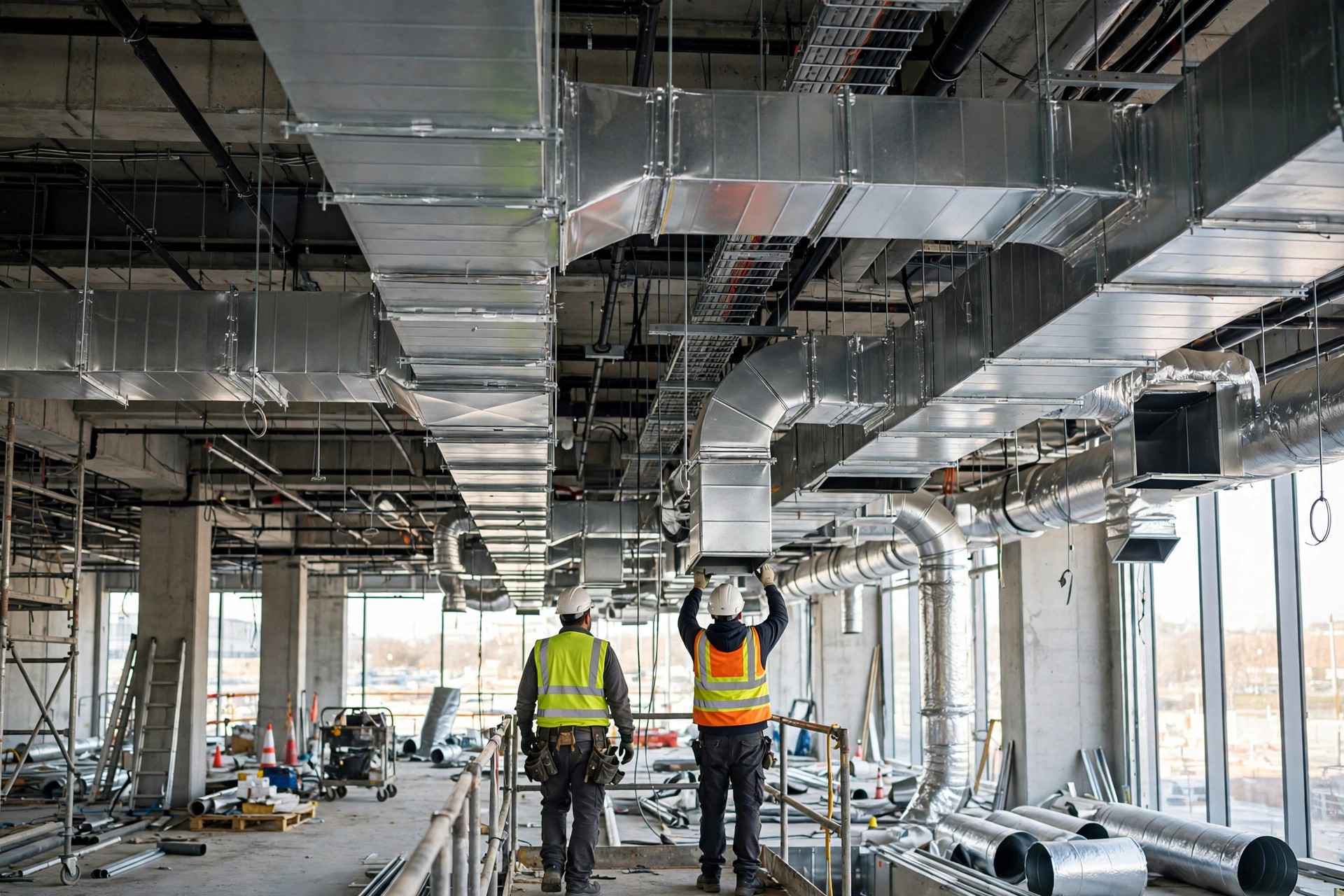
Ducts are the hidden highways of your building. They carry heated and cooled air from the equipment to every room. Bad ducts waste energy, starve rooms of airflow, and wear out your HVAC system early. Good ducts do their job quietly for decades.
When ducts need replacement or a new building needs them from scratch, owners ask one question first. What is the ductwork installation cost? This guide breaks down the six price factors, the material choices, and how to get bids you can trust.
What ductwork does in a commercial building
Ducts move conditioned air from rooftop units or air handlers to diffusers in each space. Return ducts carry room air back to be filtered and reconditioned. The system only works when both sides flow freely.
Leaky or undersized ducts ruin performance. The Department of Energy notes that duct leaks can waste a large share of heating and cooling energy. Sealing and sizing ducts right is one of the cheapest ways to cut power bills. See https://www.energy.gov/.
A full ductwork installation cost covers design, materials, labor, and testing. Each part matters, and cutting any one of them raises the true ductwork installation cost over time through wasted energy. A cheap install with poor design costs more in energy waste than it saves up front.
Price factor 1: building size and layout
Bigger buildings need more duct. That is simple. But layout matters as much as size. A wide open warehouse needs less duct per square foot than a maze of small offices.
Long duct runs cost more in material and labor. They also need larger sizes to push air the full distance. Multi-story buildings add vertical risers and fire dampers, which raise the ductwork installation cost further.
Open ceilings look modern but complicate duct runs, which lifts the ductwork installation cost for exposed designs. Exposed spiral ducts cost more per foot than hidden rectangular runs but look better and install faster in open spaces.
Price factor 2: duct material
Three materials cover most jobs. Each prices differently.
Galvanized sheet metal is the standard. It lasts long, holds its shape, and meets code everywhere. Rectangular and round metal ducts cost more in labor because each piece is cut and joined on site or in a shop.
Flexible duct costs less and installs fast. It suits short runs and tight spaces. But it crushes easily and adds friction that cuts airflow. Long flex runs are a common cause of poor performance.
Fiberglass duct board insulates itself and cuts noise. It costs less than metal in some markets. It needs careful handling to avoid fiber release into the air stream.
Material choice moves the price by a wide margin. Ask each bidder what material they quote and why, and how it affects the total ductwork installation cost.
Price factor 3: system design complexity
A simple single zone system costs least. One unit, one set of ducts, one thermostat. Small shops and offices often fit this mold.
Multi-zone systems cost more. Dampers, zone controls, and separate thermostats add parts and labor. But zoning saves energy by conditioning only occupied areas.
Variable air volume systems are the most complex. They adjust airflow to each zone through the day. They suit large offices with changing loads. Design fees run higher, but energy savings follow.
Good design pays for itself. A Manual D duct design, the industry standard from ACCA, sizes every run for proper airflow. Ask if your bid includes it.
Price factor 4: labor and access
Labor is often the biggest slice of the total ductwork installation cost. Rates vary by city and by trade demand. Big metros cost more than small towns.
Access shapes labor hours. Open new construction is fastest. Retrofits in finished buildings take longer. Crews work around occupants, protect finishes, and fish ducts through tight ceilings.
High ceilings add lift rental and slow the work. Rooftop units need curb adapters and roof penetrations. Each complication adds hours.
Price factor 5: old duct removal
Replacing old ducts adds demolition to the bill. Crews must cut out the old system, haul it away, and dispose of it. Old fiberglass and dirty metal take time to remove safely.
Asbestos is the wild card. Some old buildings wrap ducts in asbestos insulation. If testing finds it, licensed abatement must come first. That work follows strict rules and adds real cost. Test before you budget.
Price factor 6: testing and commissioning
The best installs end with testing. A tech measures airflow at each diffuser and adjusts dampers to balance the system. This step, called air balancing, makes sure every room gets its share.
Duct leakage testing finds holes the eye misses. A duct blaster pressurizes the system and measures leakage. Fixing leaks found this way can cut energy waste sharply.
Ask if testing is in the bid. Some low bids skip it. Without testing, you pay full price for unknown performance. A complete quote should include verification that the system works as designed. If testing is missing, the stated ductwork installation cost is not the full story.
Checklist: getting fair duct bids
- Does each bid include a proper duct design, not just a guess?
- What duct material is quoted for each section?
- Is old duct removal and disposal itemized?
- Are fire dampers and code items included?
- Does the price cover air balancing and leakage testing?
- How will the crew protect finished spaces during a retrofit?
- What is the workmanship warranty?
- Are permits included?
- How long will the job take, and what are the work hours?
- Who is the project lead, and how do you reach them?
Compare bids line by line. The cheapest number on paper can be the priciest in practice if it skips design and testing, so judge ductwork installation cost on what is included, not just the bottom line. For help vetting firms, see our guide on how to find a commercial HVAC contractor.
Signs your ducts need replacement
Some ducts can be sealed and saved. Others should go. Know the difference.
Crushed or disconnected runs are common in old buildings. Flex duct sags and kinks over time. Metal ducts separate at joints. If many runs are damaged, replacement beats patching.
Mold inside ducts is a health issue. It grows where moisture enters through leaks. Cleaning helps only if the moisture source is fixed. Badly affected sections should be replaced.
Undersized ducts starve rooms forever. No amount of sealing fixes a duct that is simply too small. A pro can measure and tell you.
Rising energy bills with no other cause point to duct losses. If the equipment is fine but bills climb, the ducts are a prime suspect. Our commercial HVAC services guide covers full system evaluations.
Maintenance that protects your investment
New ducts need little care, but not zero. Change filters on schedule. Clogged filters raise pressure and strain duct joints.
Inspect accessible ducts yearly. Look for separated joints, crushed flex, and water stains. Fix small issues before they grow.
Keep the building pressure balanced. Exhaust fans without makeup air pull ducts into negative pressure, which sucks in dust and unconditioned air. ASHRAE publishes ventilation standards that good contractors follow. Learn more at https://www.ashrae.org/.
When ductwork installation cost pays for itself
New ducts pay back in three ways. Energy bills drop when leaks and restrictions disappear. Equipment lasts longer because it no longer strains against bad airflow. Comfort complaints fall, which matters in leased space where tenants can leave. Add those three savings over ten years and the ductwork installation cost often pays for itself. Ask your contractor to estimate the energy savings in writing so you can see the payback math.
Frequently asked questions about ductwork installation cost
How long does a ductwork install take?
A small office can take a few days. A large retrofit can run several weeks. New construction follows the building schedule. Ask for a written timeline.
Can new ducts reuse the old layout?
Sometimes. If the old layout was designed well, new ducts can follow the same paths. But many old systems were never designed right. A fresh design often performs better.
Does ductwork installation cost include the HVAC unit?
Usually not. Duct bids cover ducts, dampers, diffusers, and grilles. Equipment is quoted separately. Make sure you know which bid covers what.
Should ducts be insulated?
Supply ducts in unconditioned spaces must be insulated by code in most areas. Insulation prevents energy loss and condensation. Return ducts in ceiling plenums may not need it. Your contractor should know local rules.
How do I know the ducts were installed right?
Ask for the air balance report and leakage test results. Walk the job and look at the workmanship. Straight runs, sealed joints, and supported ducts are good signs. Our commercial HVAC repair cost guide helps you judge fair pricing on follow-up work.
Ductwork installation cost reflects real work: design, material, skilled labor, and testing. Owners who understand each piece of the ductwork installation cost negotiate from strength. Do not buy on price alone. Get itemized bids with a real duct design. Insist on balancing and leakage testing. Then maintain the system with clean filters and yearly checks. Good ducts will serve your building quietly for decades.



