
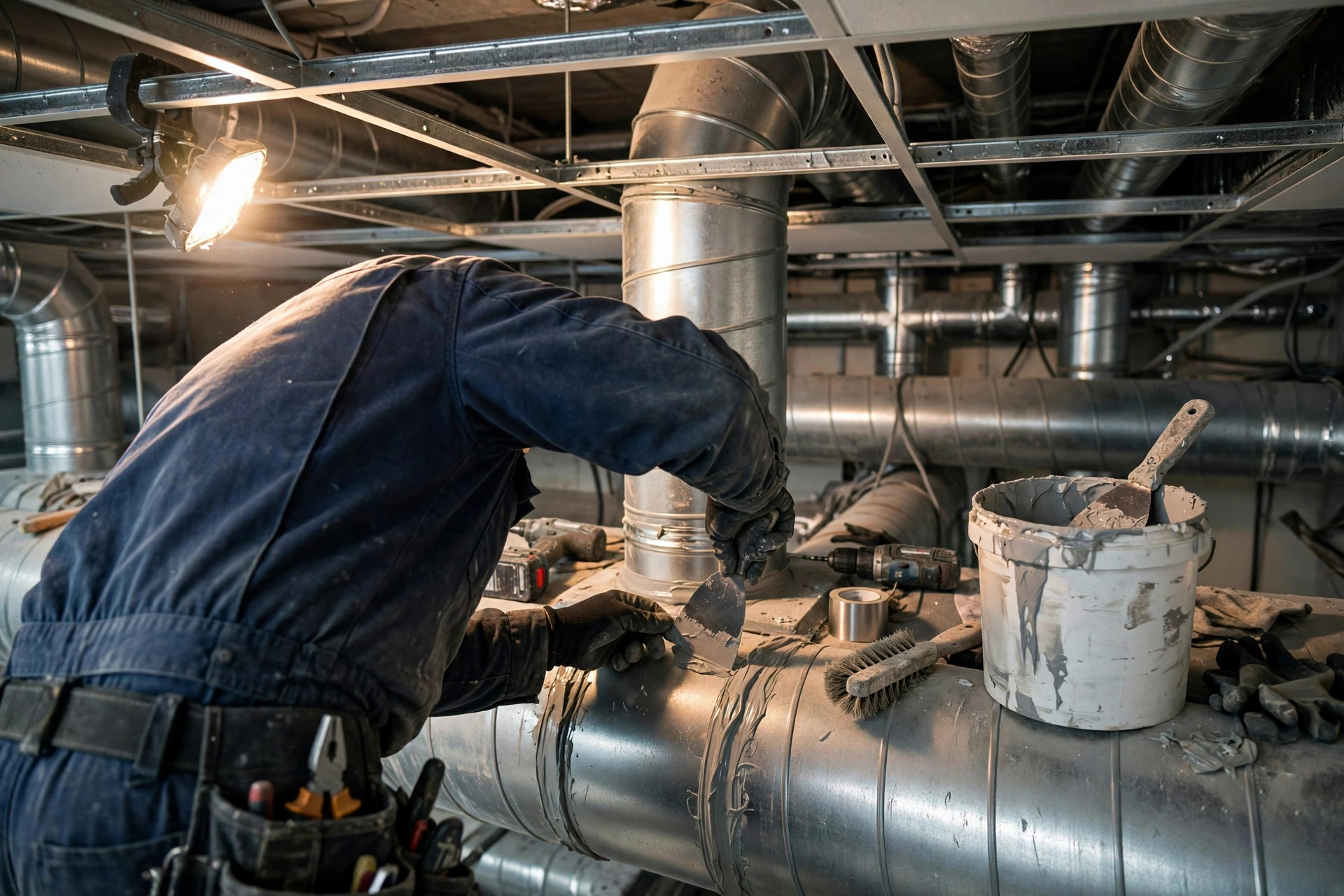
Leaky ducts are one of the quietest money drains in a commercial building. The air conditioner works hard, the power meter spins, and half the cool air never reaches the rooms. Ac duct sealing fixes that problem at the source by closing the gaps, cracks, and loose joints where conditioned air escapes.
This guide explains what ac duct sealing is, how contractors do it, what it costs, and what kind of savings to expect. If your building has uneven temperatures or high cooling bills, the ducts are a good place to start looking.
What ac duct sealing means in a commercial building
Ac duct sealing is the process of finding and closing leaks in the duct system that carries cooled air from the air conditioner to each room. In commercial buildings, ducts run above ceilings, through shafts, and across rooftops. Every joint, seam, and connection is a possible leak point. Over time, seals dry out, tape peels off, and sections pull apart.
The leaks matter more than most owners think. Federal energy experts have long noted that duct leakage can waste a large share of the energy a cooling system uses. That waste shows up as higher electric bills, rooms that never get cool enough, and equipment that runs longer and wears out sooner. Ac duct sealing puts that lost air back to work.
Sealing is different from insulating, though the two often go together. Sealing closes the holes. Insulation wraps the ducts to slow heat gain. A good project does both where the ducts run through hot attics or across sun-baked roofs. Together they can make an old duct system perform much closer to new.
How contractors perform ac duct sealing
The job starts with testing. A contractor seals off the registers, hooks a fan to the duct system, and measures how much air leaks out. This duct leakage test gives a number the owner can understand and a baseline to improve on. Good contractors test before and after so you can see what the money bought.
Manual sealing is the traditional method. A technician walks the accessible ducts and seals every joint with mastic, the thick paste made for the job, or with approved metal tape. Screws and straps tighten loose sections. This hands-on approach to ac duct sealing works well where ducts are easy to reach, like open warehouses and drop-ceiling offices.
Aerosol sealing is the newer method. The contractor blocks the registers, pressurizes the system, and injects a fine mist of sealant particles into the ducts. The particles collect at the leak points and build up until the holes close. This method reaches leaks hidden inside walls and shafts that no technician could touch by hand. It costs more than manual work but seals leaks nothing else can reach.
After the sealing, the contractor retests. The second test should show a sharp drop in leakage. Many jobs also include rebalancing the airflow so each zone gets its design share. A full ac duct sealing project ends with a written report showing the before and after numbers.
The 7 benefits of ac duct sealing
- Lower cooling bills. Sealed ducts deliver the cool air you already paid to make, so the system runs less.
- Even temperatures. Rooms at the end of long runs finally get their share of air.
- Less equipment strain. The air conditioner cycles less and lasts longer.
- Better indoor air quality. Sealed returns pull less dust and dirt from ceiling spaces.
- Quieter operation. Whistling leaks and rattling joints go away.
- Smaller carbon footprint. Less wasted energy means lower emissions from the building.
- Proof of results. Before-and-after testing shows exactly what improved.
The U.S. Department of Energy offers plain guidance on duct sealing for buildings at https://www.energy.gov/. ENERGY STAR also covers duct efficiency in its commercial building resources at https://www.energystar.gov/.
What ac duct sealing costs
For a small commercial space, manual ac duct sealing can run a few thousand dollars. Larger buildings with long duct runs cost more, and aerosol sealing adds to the price because of the equipment and material involved. Most contractors price by the size of the system and the access conditions, not by a flat rate.
Payback is where the job shines. In buildings with badly leaking ducts, the energy savings can repay the cost in a few cooling seasons. Buildings in hot climates with long cooling seasons see the fastest payback. Even in milder climates, the comfort gains alone are worth it to many owners.
Watch out for bids that skip the testing. A contractor who will not test before and after is asking you to take the results on faith. Testing is cheap compared to the job, and it is the only way to know the ac duct sealing actually worked. Put the target leakage number in the contract.
When ac duct sealing is not enough
Sealing fixes leaks, but it cannot fix every duct problem. Ducts that are crushed, rusted through, or lined with mold need replacement, not sealant. A good contractor will tell you honestly when the ducts are past saving. Pouring money into ac duct sealing on ducts that should be torn out is one of the most common wastes in this trade.
Bad duct design is another limit. Some buildings have ducts that were never sized right, with long skinny runs feeding big rooms or sharp turns choking the airflow. Sealing these ducts stops the leaks but leaves the design flaws. In those cases the right fix is a redesign of the worst runs, sometimes combined with sealing the runs that are worth keeping.
Insulation failures also go beyond sealing. If the insulation on rooftop ducts has soaked up water or crumbled away, the ducts lose cooling to the hot air around them even when every joint is tight. The fix is new insulation, or new insulated ducts, on top of the sealing work. Ask the contractor to check insulation condition during the first walkthrough.
Age matters too. Ducts past thirty years often have a mix of problems: leaks, thin spots, failing hangers, and outdated materials. At that point a full replacement usually beats a sealing job on total value. The replacement costs more up front but gives you a fresh system with a full service life ahead of it.
Ac duct sealing: a project checklist
- Get a duct leakage test first, with the result in writing.
- Ask which method fits your building: manual, aerosol, or both.
- Confirm that insulation upgrades are included where ducts run through hot spaces.
- Ask how registers, dampers, and fire dampers will be protected during the work.
- Get the target post-sealing leakage number written into the contract.
- Ask for a retest after the work, with the new number in the final report.
- Ask whether airflow balancing is included after sealing.
- Check that the sealant materials meet local code and fire rules.
- Get a warranty on the sealing work itself.
For ongoing care after the sealing, see our guide to commercial AC maintenance and the commercial AC maintenance plan that keeps systems efficient. If your ducts are too far gone to seal, read about commercial HVAC service options including replacement.
Questions owners ask about ac duct sealing
How do I know my ducts are leaking?
High cooling bills, rooms that never get comfortable, and dusty supply air are the classic signs. A duct leakage test gives you the real answer in under an hour. Many contractors offer the test at a low flat fee.
Will ac duct sealing fix hot and cold spots?
Often yes, if leaks are the cause. Sealing restores the designed airflow to each zone. If the spots come from bad duct design or an undersized unit, sealing helps but will not fully fix the problem. A good contractor will tell you which one you have.
How long does the sealing last?
Mastic and proper tape last many years. Aerosol sealant is rated for a long service life as well. The seals fail early only when ducts move, vibrate loose, or get damaged during other work above the ceiling.
Can the building stay open during the work?
Usually yes. Manual sealing above a drop ceiling is quiet work. Aerosol sealing needs the system shut down for a few hours while the mist circulates. Most contractors schedule that part for early morning or after hours.
Is ac duct sealing worth it on an old system?
It can be, if the equipment itself is healthy. Sealing old ducts connected to a failing air conditioner is poor planning. Fix or replace the equipment first, then seal the ducts. The American Society of Heating, Refrigerating and Air-Conditioning Engineers sets duct construction standards worth knowing at https://www.ashrae.org/.
Your next steps
Start with a duct leakage test so you know what you are dealing with. If the numbers show real leakage, get two or three bids that include before-and-after testing in writing. Ac duct sealing is one of the fastest paybacks in commercial HVAC, and the comfort gains show up the first day the system runs.



