
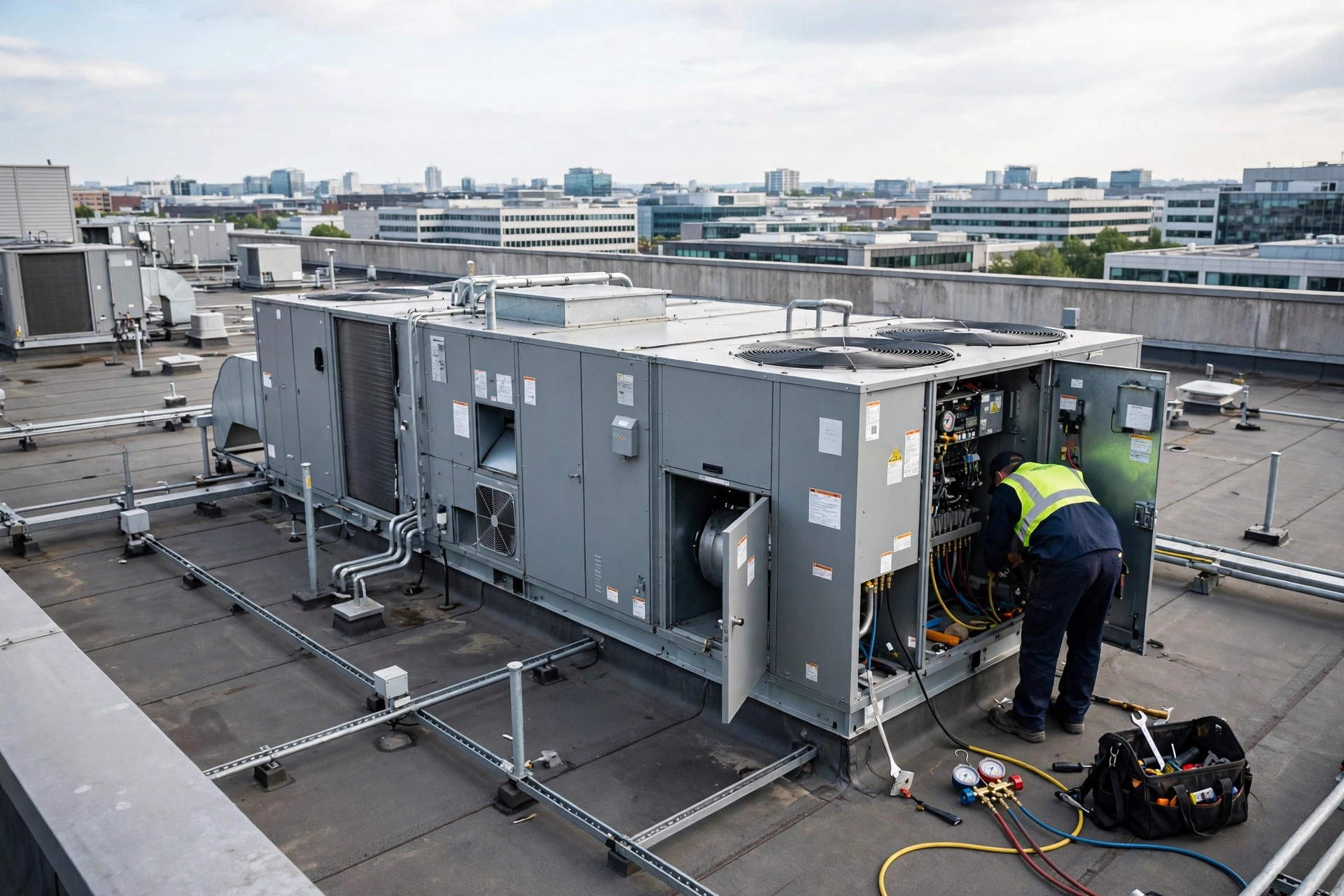
Your building runs on heat and cool air. When hvac commercial service fails, tenants complain and work stops. This guide explains what the service covers, what it costs, and how to buy it smart. Read it before you sign any contract.
Good hvac commercial service keeps equipment alive for years. Bad service means surprise breakdowns at the worst hour. The difference is rarely the brand of equipment. It is the quality of the care. This guide shows you how to judge that quality.
What hvac commercial service Covers
Hvac commercial service covers the heating, cooling, and ventilation systems in non-residential buildings. Rooftop units, chillers, boilers, air handlers, and controls all fall under it. The techs who do this work hold special licenses. The systems are bigger and more complex than home units.
Service comes in three kinds. Repair fixes what broke. Maintenance prevents breaks. Replacement swaps dead equipment. Most buildings need all three over time. A steady provider handles each one.
The scope runs wide. Filter changes, coil cleaning, belt checks, refrigerant tests, control tuning, and duct inspection are routine. Emergency calls, code compliance work, and indoor air quality fixes are common too. A full hvac commercial service plan covers the routine list on a set schedule.
9 Cost Facts About hvac commercial service
Prices vary by region and equipment. These nine facts keep you grounded.
- The service call has a base fee. &Quot;Most providers charge a trip and diagnostic fee. It covers the drive and the first hour of testing. Ask the amount before you book. It applies even if you decline the repair."
- Maintenance plans cost less per visit. &Quot;A plan bundles visits at a set price. Two to four visits a year is common. Per-visit cost drops well below the one-time rate. Plans also jump the queue for emergencies."
- Equipment type moves the price. &Quot;A small rooftop unit services fast. A chiller or boiler takes hours. Older units take longer than new ones. Ask how your equipment prices against others in your building class."
- After-hours calls cost more. &Quot;Nights, weekends, and holidays carry premiums. Rates can run half again the day rate or more. If the failure can wait for morning, waiting saves real money. Know your tolerance for heat before the failure."
- Parts vary widely. &Quot;A contactor costs little. A compressor costs a lot. Ask for part numbers and check prices yourself. Markups of two to three times are common and often fair. Markups of five times deserve a question."
- Refrigerant is expensive now. &Quot;Older refrigerants cost more every season. Leaks get pricey fast. Ask the tech to find and fix the leak, not just refill. Refills without repair are money poured into air."
- Controls work is skilled labor. &Quot;Modern systems run on software and sensors. Diagnosing control faults takes a trained tech and real time. This work prices higher than filter changes. It is worth it. Bad controls waste energy every hour of every day."
- Contracts beat one-offs over time. &Quot;A building on a steady hvac commercial service plan sees fewer breakdowns. Maintained systems use less energy and last longer. The plan pays for itself in avoided repairs and lower utility bills."
- Deferred work costs triple. &Quot;A cheap belt ignored becomes a dead motor. A dirty coil becomes a dead compressor. Small fixes now beat big bills later. This is the oldest fact in the trade. Act on the small list before it grows."
- Visit count per year and what each visit includes.
- Filter, coil, belt, and drain tasks named by unit.
- Refrigerant check and leak test method.
- Controls and thermostat calibration steps.
- Written report after every visit, kept in your file.
- Emergency response time in writing.
- Parts discount and labor rate under the plan.
- End-of-season summary with equipment condition notes.
Warning Signs You Need hvac commercial service
Equipment talks before it fails. Listen. Uneven temperatures across rooms mean airflow or control trouble. Short cycling means the unit starts and stops too fast. Strange noise means belts, bearings, or fans are wearing out.
Watch the bills. A sudden jump in energy cost with no rate change points at the HVAC. Watch the air. Musty smells point at drain or coil trouble. Dust everywhere points at filter or duct trouble. Sticky humidity points at a unit that no longer dehumidifies.
Call before the full break. A tech visit now costs far less than an emergency swap later. Describe the signs when you call. A good dispatcher will tell you if it can wait for a scheduled slot. Honest shops do not push panic.
Picking a Provider for hvac commercial service
License and insurance come first. The state licenses HVAC techs. Ask for the number and check it. Ask for the insurance certificate and confirm it is active. Refrigerant handling needs special certification. Ask for that card too.
Ask about your equipment by name. A provider that services your unit type weekly will know its weak points. Ask how many buildings like yours they hold under contract. Steady clients signal steady work. Ask how long techs stay with the firm. High turnover means thin experience.
Test the response promise. Ask the guaranteed response time for emergencies. Ask if it is written in the contract. A promise spoken is worth little. A promise written is worth much. Check references by phone. Ask about night calls, billing fights, and callbacks.
Maintenance Checklist Worth Keeping
Use this list when you review a provider or a plan. Each item should be answered in writing.
What a Good Service Visit Looks Like
The tech arrives with the work order and the last report. They start with your complaints, not their checklist. They listen first. Then they work the units in order, one by one.
At each unit they follow the same rhythm. Inspect, test, clean, adjust, record. They show you worn parts before replacing them. They explain each finding in plain words. They rank findings by urgency. Nothing is a mystery when they leave.
The visit ends with paper. A report names each unit, the work done, and the condition found. It lists recommended future work with prices. Keep these reports. They prove maintenance for warranty claims. They also track equipment decline over time. Data beats memory.
How hvac commercial service Cuts Energy Bills
Heating and cooling eat the largest share of most building utility bills. A neglected system wastes a steady slice of that spend. Dirty coils, slipping belts, and miscalibrated controls each add their own tax. None of them announce themselves. The bill just climbs a little each month.
Regular hvac commercial service attacks each waste point. Clean coils transfer heat as designed. Tight belts move the right air volume. Calibrated controls run the unit only when needed. The savings show on the next bill. They compound every month after that.
Ask your provider to track it. A good plan includes before-and-after readings on key units. Compare the same month across visits. Numbers beat promises. If the provider cannot show savings, ask harder questions. The [U.S. Department of Energy](https://www.energy.gov/) publishes building efficiency benchmarks that help you judge the results.
Training Your Staff to Help
Your own people can extend the value of every visit. Teach the maintenance lead to change filters on schedule. Teach the front desk to log hot and cold complaints with room numbers. Teach the night crew to report odd noises. Small habits feed the tech good data.
Keep a simple log at the front desk. Date, room, complaint, unit serving it. Hand it to the tech at each visit. Patterns jump out fast. One room always cold means one damper stuck. The log turns guesses into targets.
Do not let staff open panels or touch refrigerant lines. Those tasks belong to licensed techs by law. Filters, vents, and logs are the staff list. Everything else is the provider list. Clear lines keep everyone safe.
Related Reading
For repair specifics, read [commercial hvac repair](/commercial-hvac-repair/). For cooling work in detail, see [commercial ac repair](/commercial-ac-repair/). The [American Society of Heating, Refrigerating and Air-Conditioning Engineers](https://www.ashrae.org/) sets the standards behind much of this work.
FAQ
How often does a building need hvac commercial service?
Two to four visits a year covers most buildings. Rooftop units in harsh weather need the high end. Ask the tech to set the count by your equipment and use.
Is an hvac commercial service maintenance contract worth it?
For most owners yes. It cuts breakdowns, holds priority for emergencies, and spreads cost across the year. Compare the contract price against two one-time visits. The contract usually wins.
What should a service report include?
Each unit named. Work done at each unit. Condition notes. Parts used. Recommended future work with prices. No report means no record. Demand the report every visit.
Can my own staff do any of it?
Filter changes and vent checks, yes, with training. Refrigerant, electrical, and gas work, no. Those need licensed techs by law. Split the list by skill and risk. Write down who does what.
How do I know a quote is fair?
Get three quotes on the same scope. Check part numbers against retail prices. Ask for labor hours in writing. [ENERGY STAR](https://www.energystar.gov/) publishes building efficiency guides that help you judge whether the work is really needed.
Next Steps
Walk your building this week. Note the unit types and ages. Call three providers for hvac commercial service and ask for maintenance plan quotes. Compare the visit lists, not just the price. Pick the provider with the best written plan and real references. Good care now means quiet equipment for years.



