
Sooner or later every commercial air conditioner reaches the end. The repairs get bigger, the breakdowns get more frequent, and the energy bills keep climbing. Then comes the question every owner dreads: what is the ac unit replacement cost? The answer shapes the capital budget for years.
This guide explains the ten factors behind ac unit replacement cost, typical ranges for commercial buildings, and how to decide whether to repair or replace.
The 10 factors behind ac unit replacement cost
- Unit size. Bigger capacity costs more. Commercial units run from a few tons to dozens of tons, and the price climbs with size.
- Efficiency rating. Higher efficiency costs more up front and less every month. The premium pays back fastest in hot climates with long cooling seasons.
- System type. A basic rooftop unit costs less than a VRF system or a chiller. The complexity of the system sets the base price.
- Installation difficulty. Easy curb swaps cost the least. Crane lifts, tight sites, and electrical upgrades add thousands.
- Ductwork condition. New ducts add to the project. Reusing sound ducts saves money. Bad ducts should be fixed with the unit.
- Refrigerant and code. Current refrigerants and code requirements shape equipment choices. Phased-out refrigerants push old units toward replacement.
- Controls. Basic thermostats are cheap. Building automation and smart controls add cost and cut operating expense.
- Brand and warranty. Premium brands and longer warranties cost more. The value shows in reliability and parts availability.
- Labor market. Installation is skilled work. Rates vary by city and season.
- Timing. Emergency summer replacements cost more than planned spring projects. Planning ahead is the cheapest option.
The U.S. Department of Energy covers commercial cooling efficiency at https://www.energy.gov/. ENERGY STAR lists certified commercial equipment at https://www.energystar.gov/.
Typical ac unit replacement cost ranges
Small commercial units, a few tons for a shop or small office, often run in the low five figures installed. These are straightforward swaps with short lead times. The ac unit replacement cost stays manageable when the curb, ducts, and electrical all reuse cleanly.
Mid-size rooftop units for offices and retail land in the mid five figures. Larger capacity, heavier lifts, and more complex tie-ins push the number up. Most commercial replacements fall in this band.
Large systems for big buildings run into six figures. Multiple units, structural work, new ductwork, and building automation all add up. These are capital projects with engineering, permits, and phased schedules.
These ranges are planning figures. Your building’s number comes from contractors who see the site. Always get installed pricing with the full scope, not equipment-only numbers.
Repair or replace: making the call
Age leads the decision. Past fifteen years, major repairs deserve a replacement quote alongside the repair quote. Past twenty years, replacement usually wins outright. Equipment this old is inefficient by modern standards and parts get scarce.
The half-rule helps. When a single repair costs half or more of a new unit, replacement is usually smarter. The repaired old unit still has old efficiency and old age. The new unit brings a fresh warranty and lower bills.
Refrigerant type can force the call. Units running phased-out refrigerants face expensive recharges. A leak on such a unit is often the moment owners choose replacement. Check your unit’s refrigerant before the crisis.
Reliability matters as much as math. A unit that breaks every summer disrupts the business. Tenants notice. Customers notice. The ac unit replacement cost buys reliability as well as efficiency. Put a price on the disruptions when you decide.
For a detailed comparison, read AC repair vs replace for commercial buildings. For repair-side guidance, see commercial AC repair. And for the budget view, see commercial HVAC repair cost.
Financing the ac unit replacement cost
Few owners write a six-figure check from cash flow. Equipment loans, commercial leases, and contractor financing all exist for HVAC projects. Start with your bank for the best terms. Compare the total cost including interest, not just the monthly payment. A low monthly number on a long term can cost more overall.
Energy-efficiency loans deserve a look. New high-efficiency units cut power bills enough that some lenders count the savings toward the payment. Utility rebate programs can knock thousands off the ac unit replacement cost. Most require pre-approval before the work starts, so ask early.
Leasing is another path. An operating lease spreads the cost and may offer tax advantages. Read the end-of-term terms carefully. Some leases are fair. Some are traps. Have your accountant review any lease before signing.
Phase the project when the budget is tight. Replace the oldest or most critical unit this year and the rest on a schedule. A good contractor plans the phases so each stands alone. This spreads the ac unit replacement cost across budget years without leaving the building half-served.
Cutting the ac unit replacement cost without cutting corners
Time the project for the off-season. Spring and fall bring better pricing and faster scheduling than the summer rush. Contractors sharpen their pencils when the calendar has gaps. Planning a replacement six months ahead beats an emergency July swap on price every time.
Reuse what is sound. A good curb, sound ducts, and adequate electrical all cut the installed price. Do not replace what works. But do not reuse what is failing either. A new unit on bad ducts is money half spent. Inspect honestly and reuse selectively.
Get three real bids. Competition is the strongest price control in construction. Make the scope identical across bidders so the numbers compare. Then negotiate from knowledge, not from hope. The ac unit replacement cost drops when bidders know you are comparing.
Right-size the equipment. Oversized units cost more to buy and more to run. The load calculation protects you from the contractor who sizes by habit. The right size is the cheapest size over the life of the unit.
Getting the replacement right
Start with a load calculation. Buildings change over the years: walls move, occupancy shifts, equipment adds heat. The old unit’s size may be wrong for today’s load. A proper calculation sizes the new unit to reality. The American Society of Heating, Refrigerating and Air-Conditioning Engineers publishes the methods at https://www.ashrae.org/.
Match the curb when possible. A new unit that fits the existing roof curb saves adapter costs and roof work. Confirm the footprint, the duct connections, and the electrical before ordering. Lead times run weeks, so order early.
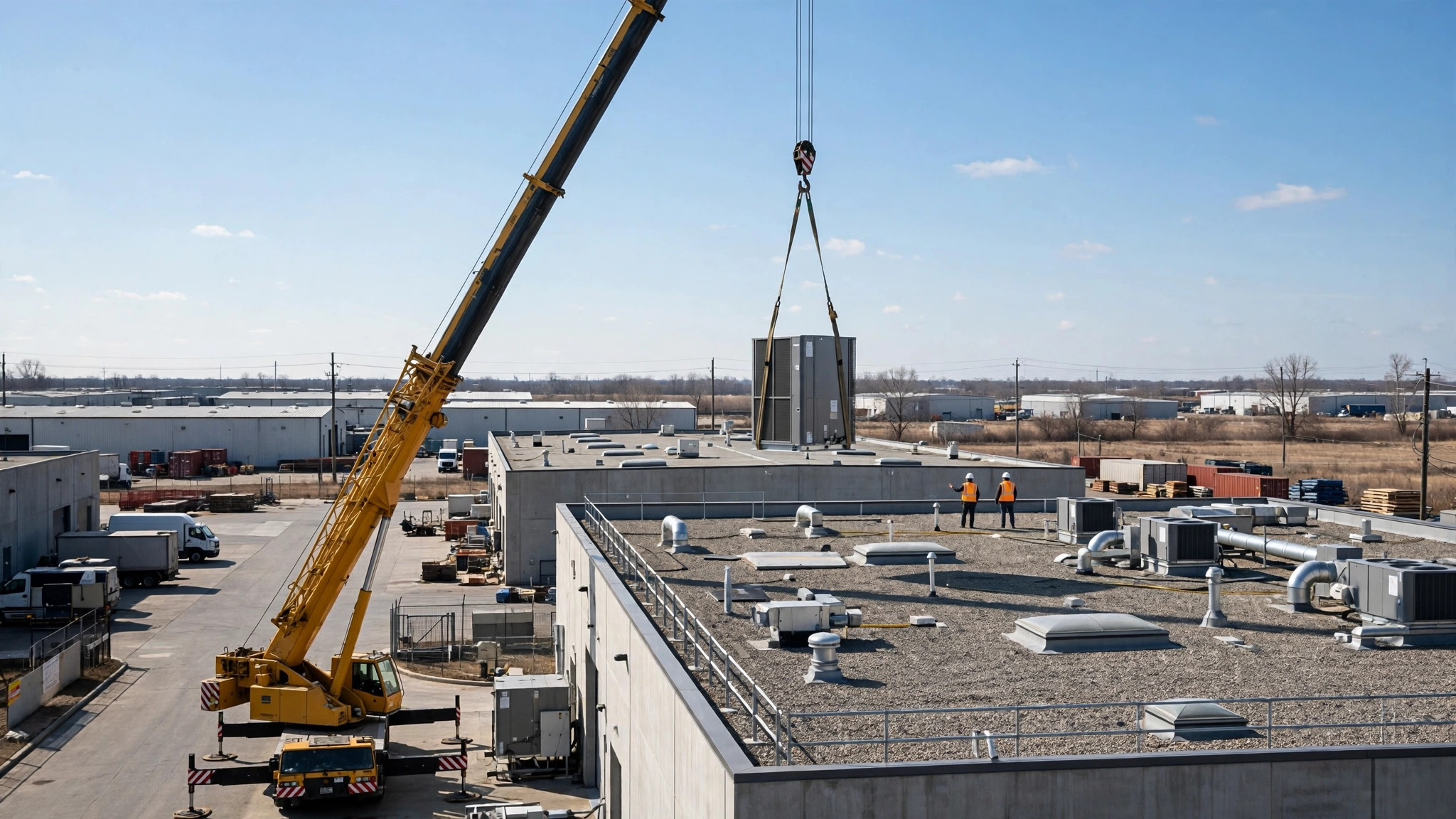
Plan the lift. Rooftop units need cranes, clear access, and sometimes street permits. Schedule for calm weather. Confirm the roof structure handles the lift plan. Good contractors manage all of this, but owners should know the date.
Commission the new unit. Startup, testing, and control setup decide whether the new unit performs like the brochure. Get the startup report in writing. Train your staff on the new controls and the filter schedule.
Ac unit replacement cost: a project checklist
- Load calculation for each zone the unit serves.
- Equipment sized to the calculation, not to the old nameplate.
- Efficiency level chosen with payback math.
- Curb fit confirmed or adapter cost included.
- Ductwork inspected and replacement scope decided.
- Electrical capacity confirmed.
- Crane, permits, and schedule planned.
- Controls and thermostat scope defined.
- Startup and commissioning in writing.
- Warranties on equipment and labor in writing.
Questions owners ask about ac unit replacement cost
Why do quotes vary so much?
Different equipment, different scope, different assumptions. One quote reuses the curb and ducts. Another replaces them. One includes controls. Another does not. Compare line by line and the gaps explain themselves.
Should I buy the most efficient unit?
Not always. The most efficient unit costs the most. In hot climates with long seasons, it usually pays back. In mild climates, the payback stretches. Ask for the year-by-year savings and pick the efficiency whose payback fits your ownership horizon.
Can I replace units one at a time?
Yes. Buildings with multiple units often replace the worst first and the rest over the years. This spreads the ac unit replacement cost across budget cycles. Keep the refrigerants and controls compatible as you go.
How long does replacement take?
A simple swap takes a day or two on site, plus weeks of lead time for the equipment. Complex projects with ductwork and controls take weeks. Plan the schedule around your business, not around the contractor’s convenience.
What warranties should I get?
Manufacturer warranty on the compressor and parts, plus a contractor warranty on labor. Ten years on the compressor is common for good equipment. One year on labor is the minimum. Get both in writing before work starts.
Your next steps
Get the age, size, and refrigerant of every unit and write them down. When a major repair looms on an old unit, get the ac unit replacement cost quote too. Decide with both numbers, a load calculation, and the payback math in front of you. Planned replacement is a budget item. Emergency replacement is a crisis.



