
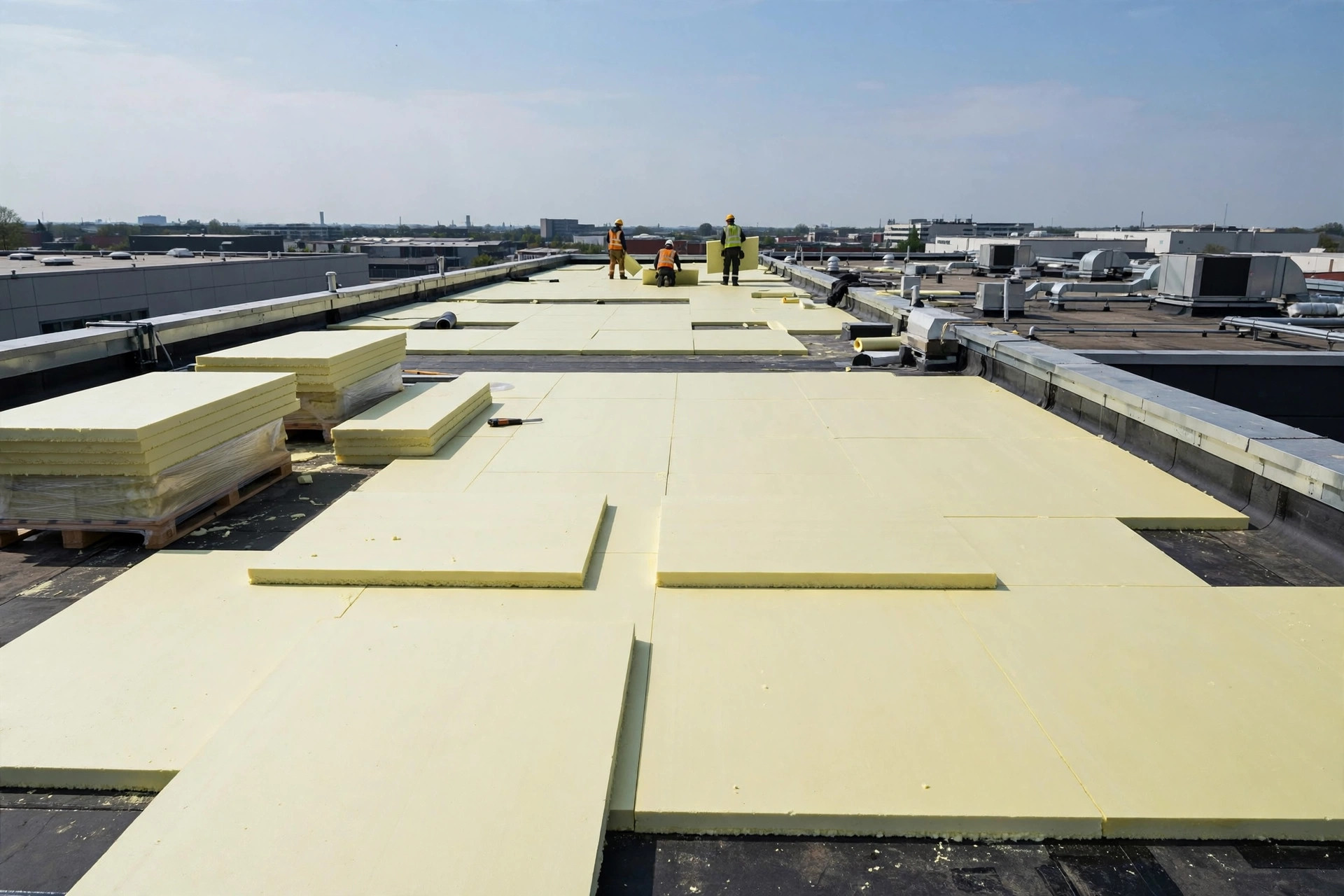
Commercial roof insulation is the hidden layer that controls energy bills. It sits under the membrane, out of sight, slowing heat flow in both directions. Good commercial roof insulation cuts heating and cooling costs for decades. Poor or wet insulation wastes money every month. This guide compares six types of commercial roof insulation. It covers R-values, costs, strengths, and best uses. It is written in plain language for US building owners and facility managers.
Why commercial roof insulation matters
Heat moves through roofs constantly. In summer, sun bakes the membrane and heat pushes into the building. The air conditioning fights it. In winter, indoor heat escapes through the roof. The furnace fights that. Commercial roof insulation slows both flows. Less heat movement means smaller equipment, lower bills, and better comfort.
Energy codes keep raising the bar. New and replacement roofs must meet minimum R-values that grow with each code cycle. R-value measures resistance to heat flow. Higher is better. A roof with twice the R-value loses about half the heat. Insulation is also the base for tapered designs that drain flat roofs. It does structural and thermal work at once.
Type 1: Polyisocyanurate (polyiso)
Polyiso is the most common commercial roof insulation. It offers the highest R-value per inch, around six per inch when new. Boards come in flat and tapered forms. Tapered boards build slope to drains on flat roofs. Two layers with staggered joints cut heat loss through gaps.
Polyiso suits almost every commercial roof. It is light, strong enough to walk on, and cost-effective. One note: its R-value drops a bit in very cold weather. Designers account for this in northern climates. For most US buildings, polyiso is the default choice and the value leader. The Department of Energy covers insulation performance at https://www.energy.gov/.
Type 2: Expanded polystyrene (EPS)
EPS is the white bead-board foam. It costs less than polyiso per inch but offers lower R-value, around four per inch. It handles moisture reasonably and keeps its R-value stable over time. It is light and easy to cut on site.
EPS suits budget jobs and roofs needing thick insulation where polyiso would cost too much. Tapered EPS systems create drainage slope affordably. The lower R-value per inch means thicker boards for the same performance. Where space allows the thickness, EPS delivers solid value. It is also common under ballasted single-ply systems.
Type 3: Extruded polystyrene (XPS)
XPS is the dense pink or blue board. It offers R-value around five per inch. Its closed-cell structure resists water absorption better than most foams. It keeps strength under load. These traits make XPS the pick for protected membrane roofs, where insulation sits above the membrane under ballast or pavers.
XPS costs more than EPS. It suits plaza decks, green roofs, and other assemblies where insulation faces water and weight. For standard membrane-over-insulation roofs, polyiso usually wins on value. But where moisture exposure is high, XPS earns its premium. Long-term R-value holds steady.
Type 4: Mineral wool
Mineral wool, made from stone or slag fibers, brings fire resistance that foams cannot match. It does not burn. It also absorbs sound well. R-value runs around four per inch. It handles high temperatures, making it popular over steel decks and near rooftop equipment heat.
Commercial roof insulation with mineral wool suits buildings with strict fire codes: hospitals, schools, and high-occupancy structures. It costs more than foam and needs careful handling to avoid compression. But where fire performance matters, it is the clear pick. Some assemblies layer mineral wool over foam for combined thermal and fire performance.
Type 5: Spray foam insulation
Spray polyurethane foam goes on as a liquid and expands into a seamless layer. It seals every gap and crack. It bonds directly to the deck. R-value runs around six per inch, similar to polyiso. It can also serve as the roofing itself when coated, though here we discuss it as insulation under membranes.
Spray foam suits odd-shaped roofs and retrofits where boards fit poorly. The seamless layer stops air leaks that boards miss. Application needs trained crews and good weather. Cost runs higher than board stock. Quality depends heavily on the applicator. For the right tricky roof, spray foam solves problems boards cannot.
Type 6: Tapered insulation systems
Tapered insulation is a design more than a material. Boards cut at a slope create drainage on flat roofs. Most tapered systems use polyiso or EPS. They slope a quarter inch per foot toward drains. Crickets, the diamond-shaped slope pieces, divert water around curbs and units.
Every flat roof needs drainage, and tapered commercial roof insulation is how most roofs get it. The added cost over flat boards pays back in roof life. Ponding water stresses membranes and voids warranties. A tapered design is the single best upgrade for a flat roof replacement. Always ask whether the bid includes tapered insulation or just flat boards.
Comparing R-value, cost, and best use
Here is the quick comparison of commercial roof insulation types.
- Polyiso: R-6 per inch, moderate cost, best all-around value, tapered options.
- EPS: R-4 per inch, lowest cost, good for thick affordable assemblies.
- XPS: R-5 per inch, higher cost, best where water and load exposure are high.
- Mineral wool: R-4 per inch, higher cost, best fire resistance and sound control.
- Spray foam: R-6 per inch, highest install cost, best for sealing odd shapes.
- Tapered systems: varies by material, adds cost, essential for flat roof drainage. Energy Star explains insulation and air sealing for commercial buildings at https://www.energystar.gov/.
Match the type to the job. Standard replacement: polyiso, tapered to drains. Budget job: EPS. Plaza or green roof: XPS. Fire-critical building: mineral wool. Tricky retrofit: spray foam. Always tapered for drainage on flat roofs.
Cost factors for commercial roof insulation
Thickness drives cost. More R-value needs more inches, which means more material and labor. Tapered systems cost more than flat boards because of cutting and layout labor. Two layers with staggered joints cost more than one layer but perform better.
Roof complexity adds labor. Cutting boards around many penetrations takes time. Large simple roofs install fast and cost less per square foot. Material prices move with petroleum markets for foam boards. Get insulation specified by type, thickness, R-value, and taper plan in every bid. Vague insulation language hides value differences. For related reading, see commercial roof repair cost per square foot and commercial roofing maintenance.
Wet insulation: the hidden enemy
Insulation only works when dry. Wet insulation loses R-value fast. It also grows mold, corrodes decks, and adds weight. A moisture survey with infrared scanning or core samples finds wet areas. Many roof failures blamed on membranes are really insulation failures underneath.
During replacement, remove all wet insulation. Installing a new membrane over soaked boards traps the problem and voids warranties. During maintenance, fix leaks fast to limit how much insulation gets wet. Small dry areas can sometimes be left, but large wet zones must come out. This is why fast leak repair matters so much.
FAQ about commercial roof insulation
How much insulation does my commercial roof need?
Local energy code sets the minimum, and it rises with each code cycle. Many US regions now require the equivalent of several inches of polyiso on replacements. Your contractor or a roofing designer can state the exact requirement. Exceeding the minimum often pays back in energy savings.
Can I add insulation without replacing the roof?
Sometimes. If the membrane is sound and codes allow another layer, rigid boards can go over the old roof under a new membrane or coating. The structure must handle the added weight and height. An overlay with new insulation is a common mid-life upgrade.
Does thicker insulation always pay off?
Up to a point. Each added inch saves less than the one before. But energy prices and code minimums keep pushing the sweet spot thicker. A simple payback calculation with your energy rates shows where your roof lands. In most cases, meeting or slightly beating code pays well.
What is the best insulation for a restaurant roof?
Grease and heat near exhausts punish some materials. Polyiso with proper protection works for most. The key is keeping grease off the roof with proper exhaust maintenance and protecting insulation from contamination during any work. Talk to a contractor experienced with restaurant roofs.
How do I know if my insulation is wet?
Signs include spongy areas underfoot, blisters in the membrane, unexplained energy bill increases, and interior leaks with no clear membrane damage. A professional moisture survey with infrared or capacitance meters maps wet areas accurately. Core samples confirm.
Next steps
Find out what insulation your roof has now: type, thickness, and condition. If a replacement is coming, get bids that specify commercial roof insulation type, thickness, R-value, and tapered drainage design. Do not accept vague insulation language. Insist on a moisture survey to find wet boards before any overlay decision. Good commercial roof insulation is invisible when it works and expensive when it does not. Choose it with the same care you give the membrane.



