
Commercial air conditioning keeps American businesses running through hot summers. Offices, retail stores, restaurants, warehouses, and schools all depend on it. Workers stay productive. Customers stay longer. Products stay safe. Yet many building owners know little about the systems cooling their space. This guide explains commercial air conditioning in plain terms. It covers seven common system types, how sizing works, what drives cost, and how to keep everything running. It is written for US building owners and facility managers.
What makes commercial air conditioning different
Home air conditioning cools one house with one thermostat. Commercial air conditioning cools larger, more complex spaces. A single building may have offices, a lobby, a server room, and a warehouse, each needing different temperatures. Commercial systems handle these zones with bigger equipment, longer duct runs, and smarter controls.
Commercial equipment also runs harder. Many systems cool ten or more hours a day, six or seven days a week. Restaurants and data centers run cooling around the clock. That heavy use means commercial air conditioning needs tougher components and more frequent service than home units. The equipment often sits on the roof, where it faces full sun, wind, and weather.
Controls are another difference. Commercial buildings use thermostats per zone, timers, and sometimes full building automation. These controls cut energy waste by cooling only the spaces in use. A good control setup can save more energy than any single equipment upgrade.
7 Types of commercial air conditioning systems
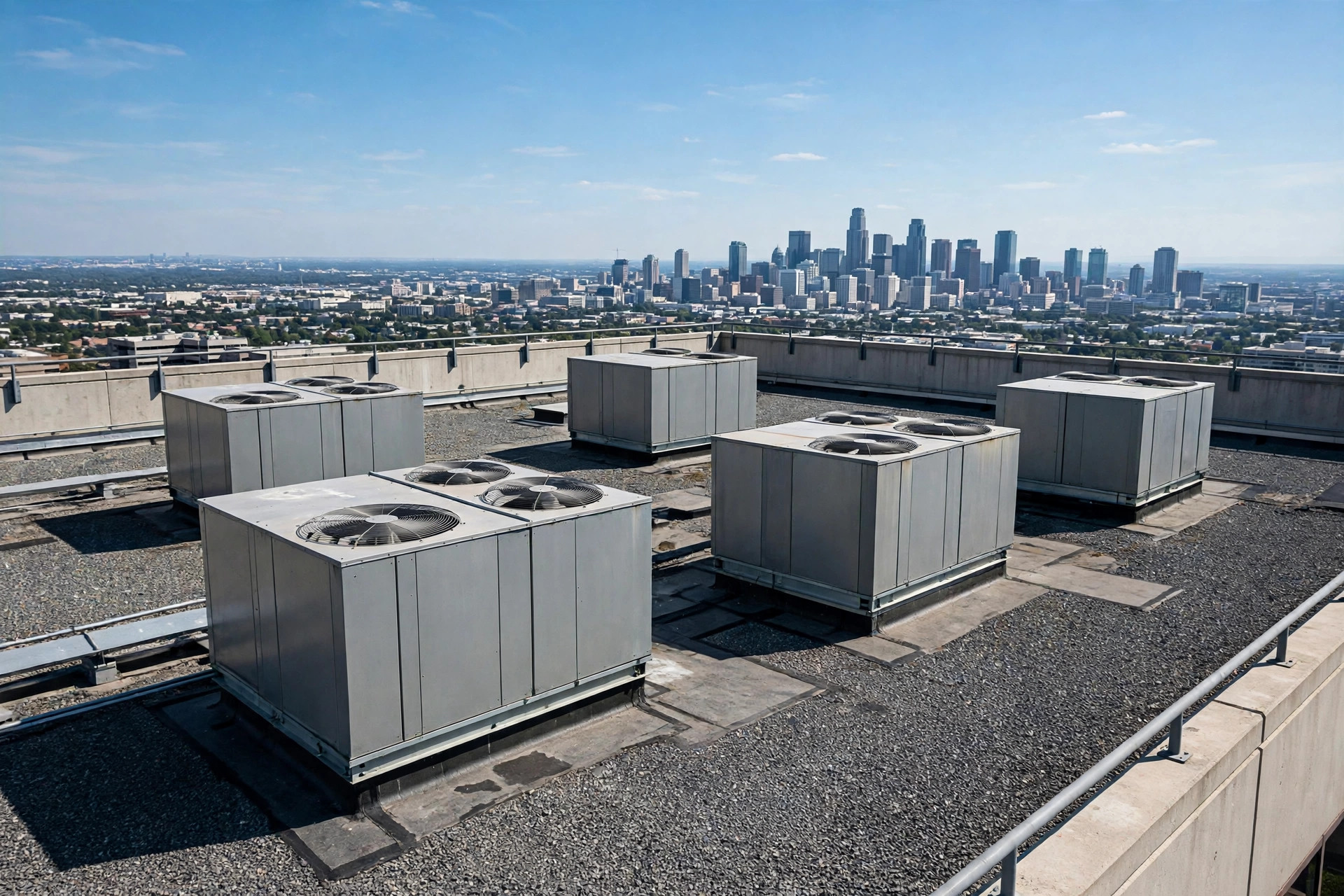
1. Packaged rooftop units. The workhorse of commercial air conditioning. A packaged unit puts the compressor, coils, and fan in one box on the roof. Each unit serves one zone. Offices, strip malls, and restaurants use them everywhere. They are simple to install and service. If one fails, only its zone loses cooling. Sizes range from small three-ton units to large fifty-ton boxes.
2. Split systems. A split system keeps the air handler indoors and the condenser outside or on the roof. The two parts connect with refrigerant lines. Split commercial air conditioning suits buildings with central mechanical rooms. It allows larger indoor components and quieter operation inside. Many mid-size offices use multiple split systems for zone control.
3. Variable refrigerant flow (VRF) systems. VRF systems connect many indoor units to one outdoor unit. Each indoor unit controls its own zone. Some zones can cool while others heat, and the system moves heat between them. VRF commercial air conditioning fits hotels, offices, and schools with many small zones. It costs more upfront but saves energy with precise zone control.
4. Chilled water systems. Large buildings often use chilled water. A central chiller cools water, pumps send it through the building, and air handlers in each zone blow air across cold coils. Chilled water commercial air conditioning serves hospitals, malls, campuses, and high-rises. It is efficient at large scale but complex and costly to install.
5. Packaged terminal units (PTAC). Hotels and motels know these well. A PTAC is a through-the-wall box that heats and cools one room. Each room controls its own unit. Commercial air conditioning with PTACs is simple and cheap to install. Efficiency is lower than central systems, and the wall sleeves need regular maintenance.
6. Evaporative coolers. In dry climates, evaporative coolers offer cheap cooling. They blow air across wet pads, cooling by evaporation. They use far less electricity than refrigerant systems. But they only work where humidity is low, and they add moisture to the air. Some warehouses and shops in the Southwest use them. They are a niche but valid form of commercial air conditioning.
7. Ductless mini-splits. Mini-splits pair a small outdoor unit with one or more indoor heads. No ductwork needed. They suit additions, small offices, server rooms, and spaces where ducts cannot fit. Modern mini-splits are very efficient. For spot cooling in a commercial building, they are often the simplest answer.
Sizing commercial air conditioning correctly
Sizing decides comfort and cost for years. Too small, and the space never cools down on hot days. Too big, and the system short-cycles. Short-cycling wastes energy, wears parts, and leaves humidity high. Sticky, clammy air is the classic sign of oversized commercial air conditioning.
Proper sizing starts with a load calculation. The contractor measures the building envelope, windows, insulation, and orientation. They count people, lighting, and heat from equipment. Server rooms, kitchens, and sun-struck glass walls add big loads. The result is the cooling load in tons. One ton equals twelve thousand BTUs per hour.
Never accept a bid based on square footage alone. Two identical buildings can need different cooling if one has a commercial kitchen and the other is a warehouse. Ask for the written load calculation. Also plan for growth. If you may add equipment or occupants later, size with some headroom or design zones that can expand. Our guide on commercial hvac services covers system planning, and signs your commercial hvac needs repair lists warnings of sizing trouble.
Cost factors for commercial air conditioning
System type sets the base cost. PTACs and mini-splits cost the least per zone. Packaged rooftop units sit in the middle. VRF and chilled water systems cost the most upfront. Building size and zone count multiply everything. A ten-zone building needs ten sets of indoor equipment or one large central plant.
Installation labor varies widely. Simple rooftop unit swaps cost far less than new ductwork through finished ceilings. Electrical upgrades add cost when the service cannot handle the load. Crane lifts for rooftop units need scheduling and sometimes street permits. Controls add cost too, but good controls pay back in energy savings.
Operating cost matters as much as install price. Efficiency ratings tell you how much cooling each unit delivers per unit of electricity. Higher efficiency costs more upfront and less every month. In hot climates, the payback is fast. Maintenance runs a few hundred dollars per unit per year and prevents the emergency calls that cost far more. The Department of Energy covers commercial cooling efficiency at https://www.energy.gov/.
Maintenance checklist for commercial air conditioning
Steady service keeps commercial air conditioning reliable. Use this checklist with your contractor.
- Change or clean air filters monthly during cooling season.
- Clean condenser coils at least once a year, more near dusty or greasy areas.
- Check refrigerant charge and fix leaks instead of just recharging.
- Inspect and tighten electrical connections, contactors, and capacitors.
- Clear condensate drains and treat against algae growth.
- Calibrate thermostats and check zone control sequences.
- Inspect ductwork for leaks, damage, and disconnected joints.
- Test economizers, which bring in cool outside air when conditions allow.
- Lubricate fan motors and check belt tension where applicable.
- Log energy use per square foot to spot efficiency losses early.
Schedule professional visits in spring before cooling season and in fall after it ends. Between visits, train building staff to check filters and report hot spots, noises, and water stains. Energy Star offers maintenance resources for commercial buildings at https://www.energystar.gov/.
Common problems and warning signs
Watch for uneven cooling between zones. It often means duct problems, control faults, or low refrigerant. Short-cycling, where units start and stop every few minutes, signals oversizing or control issues. Ice on refrigerant lines or coils points to low airflow or low refrigerant. Water stains under indoor units mean clogged condensate drains.
Rising energy bills with no change in hours or occupancy signal falling efficiency. Dirty coils and low refrigerant are the usual causes. Strange noises deserve prompt attention. Grinding suggests bearing failure. Hissing can mean a refrigerant leak. Banging may be a loose part or a failing compressor. Our articles on commercial ac not cooling and commercial hvac repair dig deeper into troubleshooting.
Do not ignore small problems in peak summer. A weak capacitor in June becomes a dead unit in a July heat wave. Fix flagged issues during planned visits. Emergency commercial service costs far more than planned repairs.
FAQ about commercial air conditioning
How long does commercial air conditioning equipment last?
Packaged rooftop units often last fifteen to twenty years with good maintenance. Split systems run similar lifespans. Chillers can last twenty-five years or more. PTACs usually run ten to fifteen years. Heavy use and poor maintenance shorten every type.
What is the most energy-efficient type?
VRF systems and high-efficiency chillers lead on efficiency for multi-zone buildings. Modern mini-splits are very efficient for small zones. For single-zone rooftops, choose the highest efficiency rating your budget allows. Good controls add savings to any type.
Can I replace just one rooftop unit and keep the rest?
Yes. Multi-unit buildings often replace units one at a time as they age out. Match the new unit’s capacity to the zone load. Mismatched old and new units can fight each other through shared controls, so have the contractor check control compatibility.
Do I need building automation for a small building?
Not necessarily. A small building with a few zones does fine with programmable thermostats. Building automation pays off in larger buildings with many zones and complex schedules. Start simple and add controls as the building grows.
How do I cut cooling costs without new equipment?
Clean coils and filters, seal duct leaks, fix controls, and use setback schedules for unoccupied hours. Economizers that use cool outside air help in mild weather. These low-cost steps often cut cooling energy noticeably before any equipment change.
Next steps
Inventory your cooling equipment this week. Note each unit’s type, age, and condition. Schedule a spring tune-up with a licensed commercial contractor and ask for a written report on every unit. Fix flagged issues before summer heat arrives. If any unit is past fifteen years with rising repair bills, get replacement quotes with a proper load calculation. Steady maintenance and timely replacement keep commercial air conditioning a quiet background utility instead of a summer crisis.



