
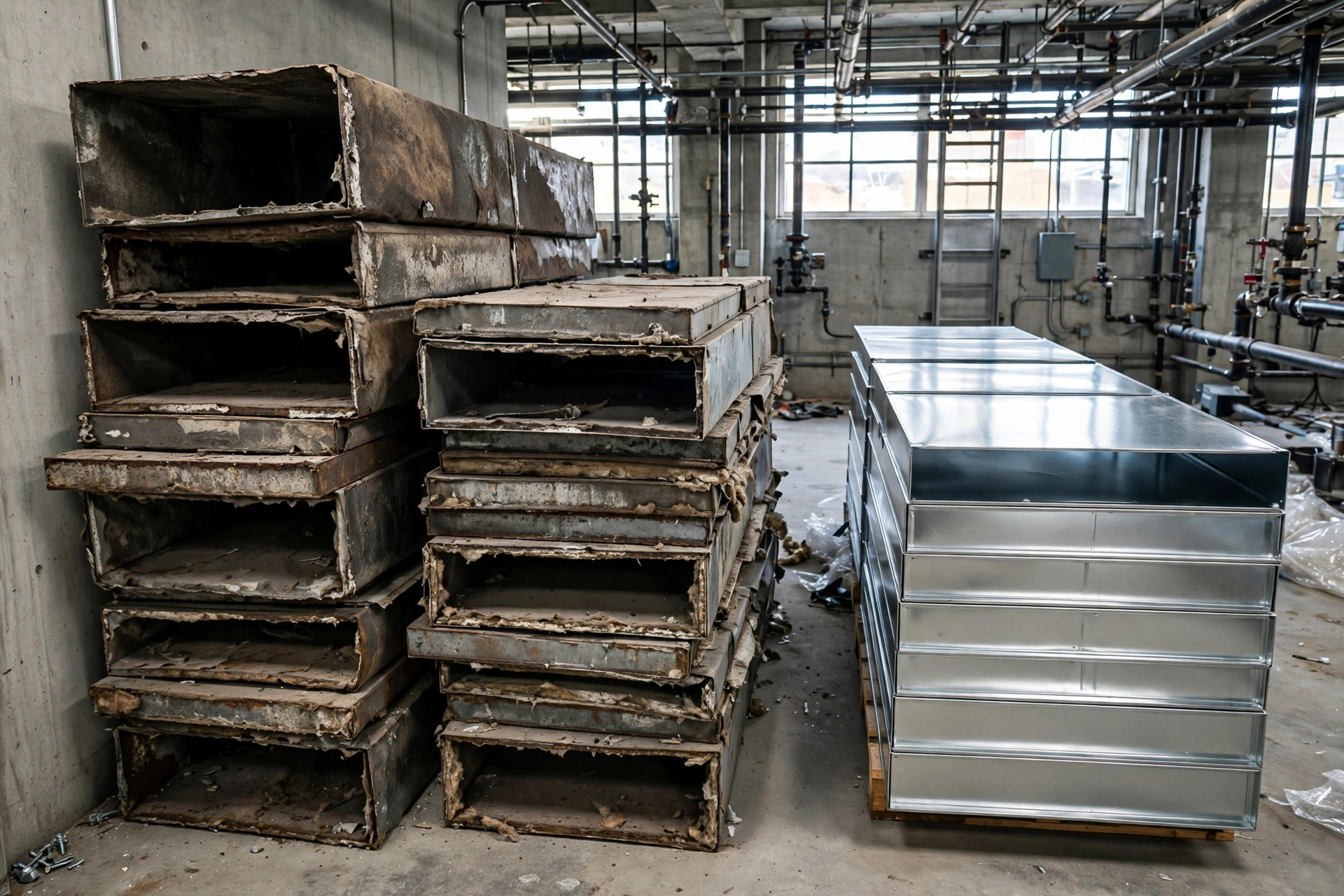
When ducts wear out, owners want one number: the air duct replacement cost. The true answer depends on the building, but the factors behind it are the same everywhere. Learn the nine factors and you can read any bid with confidence and spot the ones that do not add up.
This guide walks through what sets the air duct replacement cost in commercial buildings, typical ranges, and a checklist for getting fair comparable bids.
The 9 factors behind air duct replacement cost
- System size. More linear feet of duct means more material and labor. Large buildings cost more in total, though the per-foot price often drops with scale.
- Duct material. Sheet metal costs the most and lasts longest. Flexible duct is cheapest for short branches. Duct board sits between. The mix sets much of the material budget.
- Number of zones and branches. Each branch needs fittings, dampers, and balancing. Complex layouts with many small zones cost more than simple trunk runs.
- Ceiling type. Drop tile is easy. Hard lid drywall must be cut and patched. Open ceilings are cheapest to work in. The ceiling decides how fast the crew moves.
- Building occupancy. Working around people, especially in clinics, schools, and restaurants, means after-hours labor at higher rates. Empty buildings are cheapest.
- Old duct removal. Tearing out the old system, including disposal, is real labor. Hazardous old insulation adds specialist cost.
- Code requirements. Insulation levels, sealing standards, and fire dampers all add material and labor. Meeting code is not optional.
- Testing and balancing. Leakage testing and airflow balancing prove the job. Skilled work, real cost, never skip it.
- Local labor rates. Sheet metal mechanics charge what the market bears. The same job prices differently in different cities.
The U.S. Department of Energy explains how duct condition drives energy waste at https://www.energy.gov/. The American Society of Heating, Refrigerating and Air-Conditioning Engineers sets duct construction standards at https://www.ashrae.org/.
Typical air duct replacement cost ranges
Small commercial spaces with simple layouts often see totals in the low five figures. The runs are short, access is easy, and the job finishes in days. These are the cheapest replacements per project, though rarely the cheapest per foot.
Mid-size offices and retail buildings land in the mid five figures. Multiple zones, longer runs, and ceiling patching push the air duct replacement cost up. Expect one to three weeks of work, phased to keep the business running.
Large buildings with complex systems run into six figures. Long trunk lines, many dampers, fire-rated assemblies, and after-hours work all add up. These projects need real design and real project management, not just a crew with a truck.
These ranges assume straightforward conditions. Hazardous materials, structural surprises, or premium materials move any project above its range. That is why the bid, not the average, is the number that matters.
What drives air duct replacement cost up fastest
Bad access is the top budget killer. Ducts buried above hard ceilings, packed into tight shafts, or strung across a building that cannot shut down all slow the crew. Every slow hour bills the same. When a contractor walks your building, watch where they look. The experienced ones study the access, not just the ducts.
Scope creep is next. “While you are up there” is the most expensive sentence in construction. Adding zones, moving registers, and upgrading insulation mid-job all cost more than planning them first. Freeze the scope before bidding. Change orders should be rare, priced fairly, and in writing.
Old-building surprises follow. Asbestos in duct insulation, ducts routed through structural members that cannot be touched, and undocumented wiring in the ceiling all appear mid-job. A thorough survey before bidding catches most of them. The survey costs money. The surprises cost more.
Material choices and their effect on air duct replacement cost
Sheet metal sets the top of the material budget and the top of the quality scale. Galvanized steel trunks last for decades, take abuse from other trades, and hold their shape under high pressure. Fabrication is skilled shop work, and installation is skilled field work. When the air duct replacement cost quote shows sheet metal on the trunks, you are paying for the longest-lived option.
Flexible duct trims the material budget fast. It unrolls, bends around obstacles, and connects in minutes. That speed is real savings on simple jobs. But flex belongs on short branches, not long trunks. Long runs of flex sag between supports, and every sag chokes airflow. A low air duct replacement cost built on flex everywhere is a comfort problem waiting to happen.
Fiberglass duct board offers a middle path with a bonus: it quiets the system. Offices and clinics like the lower noise. The board must be fabricated with care and kept dry. In the right building it gives good value. In wet or rough service, sheet metal wins.
Spiral round duct costs more than rectangular but suits open ceilings where ducts show. Restaurants and retail spaces often pick it for looks. It moves air efficiently and needs fewer supports. Match the material to the run and the room, and the air duct replacement cost buys the right duct in the right place.
Financing a duct replacement project
Few owners pay six figures from petty cash. Equipment financing, commercial loans, and contractor payment plans all exist for this work. Start with your bank, since an existing relationship usually brings the best terms. Compare the total cost with interest, not just the monthly number.
Energy-efficiency financing deserves a look. Some programs lend against the projected energy savings, which duct replacement delivers in spades. Your utility may offer rebates or low-interest loans for efficiency work. Ask before the project starts, since most programs require pre-approval.
Phase the project if the budget is tight. Replace the worst zones first, then the rest next year. A good contractor designs the phasing so each phase works standalone. This stretches the air duct replacement cost across budget cycles without leaving the building half-done.
After replacement: protecting the investment
New ducts deserve a fresh maintenance habit. Change filters on schedule, because dirty filters raise system pressure and stress every joint. Keep the insulation dry in unconditioned spaces. Have the ducts inspected every few years, with a leakage retest to confirm the seals hold.
Guard the system from other trades. Electricians, plumbers, and cable installers all work above ceilings, and all of them can crush a duct or knock a joint loose. Make it a building rule: anyone working above the ceiling reports to maintenance first, and duct damage gets fixed immediately.
Keep the paperwork. The as-built layout, test reports, and warranties go in the building file. When the next contractor needs to understand the system, that file saves hours and prevents mistakes. A documented system is a protected investment.
Air duct replacement cost: a bid checklist
- Full survey with duct map, sizes, and leakage test results.
- Material schedule for every run.
- Ceiling types noted and patching responsibility named.
- Damper, register, and grille counts.
- Insulation and sealing standard per code.
- Old duct removal and disposal in writing.
- Permits and inspections listed.
- Work hours, phasing, and occupant protection plan.
- Testing and balancing with a written report.
- Material and labor warranties in writing.
For context on system costs, see commercial HVAC repair cost. For keeping the new system healthy, read commercial AC maintenance. And for full-service options, see commercial HVAC services.
Questions owners ask about air duct replacement cost
Why is labor such a big share?
Because the work is skilled and slow. Hanging, sealing, and insulating hundreds of feet of duct above a ceiling takes trained mechanics many days. Material is straightforward. Labor is where quality lives or dies.
Can I save money with flexible duct everywhere?
You can save on the bid and lose on performance. Flex is fine for short branches. Long flex runs sag, kink, and choke airflow. The energy waste and comfort problems last for decades. Use each material where it belongs.
Does new ductwork need new equipment too?
Not always. If the HVAC units are young and healthy, new ducts make them perform better. If the units are old, doing both together saves on labor and shutdowns. Price both options and decide with numbers.
How do I know the ducts are really bad?
A leakage test gives the number. A visual inspection shows crushed, rusted, or moldy sections. High bills, dusty air, and uneven temperatures tell the story from inside. Two of the three confirm it.
Will the building need to close?
Rarely. Phased work keeps most buildings running. The disruptive parts happen after hours. Talk through the phasing plan before you sign so the schedule fits your operation. The Occupational Safety and Health Administration covers jobsite safety at https://www.osha.gov/.
Your next steps
Get the survey and leakage test so you price reality, not guesses. Use the checklist to collect three bids on identical scope. Compare the breakdowns, check references, and hire the contractor whose air duct replacement cost numbers are complete and honest. The air duct replacement cost is a one-time hit. The lower bills and better comfort pay you back for years.



